


Chair yoga studies offer reasons for hope about anxiety in later life. Read the stress and cortisol findings, their limits, and how to start safely.
The appointment is still days away, but you have already rehearsed it in your mind. There is the journey, the conversation, and the question you might forget to ask. Family concerns and plans for the coming years can fill the same mental space. On a day like this, the attraction of yoga may have little to do with becoming more flexible. You want an activity you can do while the worries are still there.
A randomized chair yoga trial involving older adults found improvements in anxiety. Research in residential settings and among people living in the community gives reasons to consider yoga as an activity supporting psychological health.[19][18] Depression is the focus of a separate article in this series. Here, the questions are about apprehension, the feeling that daily demands are burdensome, and what researchers actually measured when they investigated those experiences.
The useful starting point is to separate a person’s report of stress from a laboratory measurement of a hormone. Both appear in yoga research, but they answer different questions. Yoga does not settle a family problem or remove a medical appointment from the calendar. The research offers something more specific: evidence about how people feel, how confident they are about everyday tasks, and how those outcomes change after participating. Begin with a trial in which older adults themselves took part.[19]
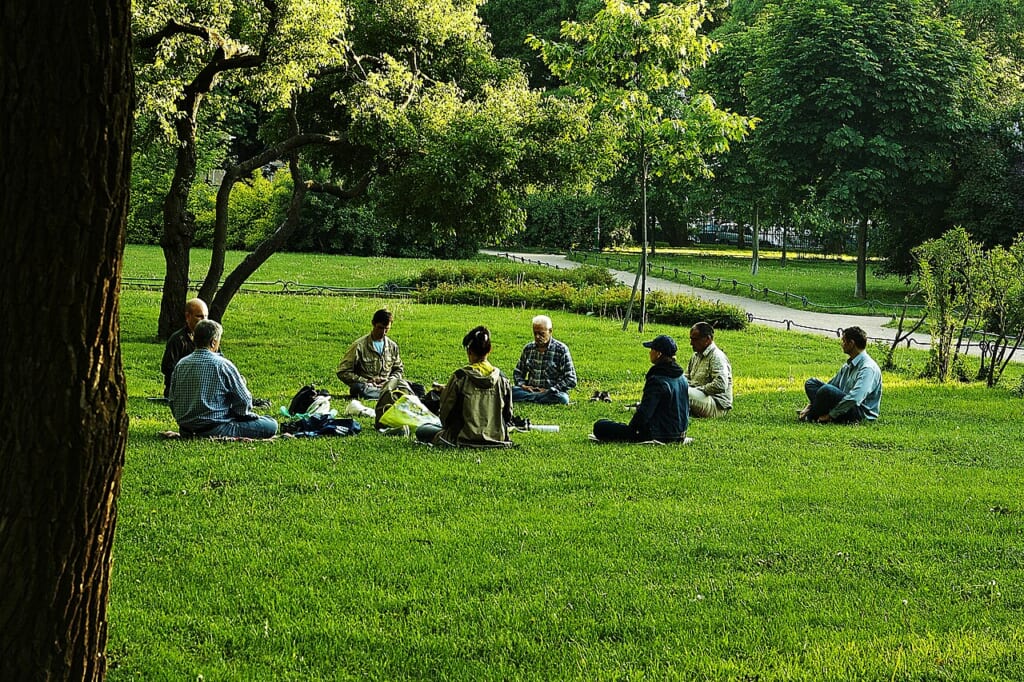
Chair yoga can change anxiety without floor poses
If sitting on the floor is difficult, it can seem as though yoga is closed to you before you have even begun. Bonura and colleagues tested a different approach. Their randomized controlled trial assigned 98 adults aged 65–92 in facilities for older adults to chair yoga, chair exercise, or a control group. The intervention lasted 6 weeks.[19] A seated form of yoga was therefore the activity under investigation, rather than a demanding sequence of floor poses.
The chair exercise comparison matters. Taking part in an activity can change a person’s schedule and create opportunities to move. By comparing chair yoga with chair exercise as well as a control group, the researchers asked a question closer to a real choice: what happened when participants did yoga rather than another seated exercise activity? Assessments took place before the intervention, immediately afterward, and at a follow-up 1 month after it ended.[19]
Yoga participants improved more than both comparison groups in anxiety, anger, well-being, general self-efficacy, and self-efficacy for daily living. The difference in anxiety improvement was larger at follow-up than immediately after the intervention.[19] That is relevant to anyone who hopes to feel more able to engage with ordinary life while still having concerns. The outcomes included confidence about handling tasks, alongside the intensity of anxiety itself.
The table gives the reported effect sizes, which describe the size of the improvement differences. Each entry lists the comparison with chair exercise first and the comparison with the control group second. These are not percentages of participants who improved.[19] Self-efficacy means the sense that you can deal with a task or challenge. The study assessed confidence in daily living separately from general confidence, rather than treating every psychological outcome as the same experience.
| Outcome | Immediately after the intervention | At the 1-month follow-up |
|---|---|---|
| Anxiety | 0.27 / 0.39 | 0.62 / 0.63 |
| Self-efficacy for daily living | 0.52 / 0.81 | 0.27 / 0.42 |
| General self-efficacy | 0.63 / 1.10 | 0.30 / 0.85 |
| Anger | 0.89 / 0.90 | 0.90 / 0.72 |
| Well-being | 0.14 / 0.49 | 0.25 / 0.61 |
All the figures in this table come from the Bonura trial.[19] The pattern is more interesting than a simple claim that everything became better by the same amount. The anxiety differences grew at follow-up, whereas the differences in daily-living confidence and general confidence were smaller than immediately after the intervention. When you consider your own reasons for participating, it is useful to keep these goals separate. Feeling less worried and feeling more able to handle an errand are related concerns, but the study measured them individually.
The researchers also reported that changes in self-control moderated changes in psychological health.[19] The trial’s purpose was to examine psychological outcomes, rather than success at a particular pose. For a reader who needs a seated activity, this changes the starting question. Instead of asking whether you can perform the movements associated with a typical yoga photograph, you can ask whether a chair-based activity is a form in which you could participate.
初日の汗は、予約した人だけが持ち帰れる。
Community participation brings a different perspective
Preliminary research on chair yoga in care homes also reported improvements in anxiety and mood.[16] That study is discussed more fully in this series’ article on depression and low mood in later life. It adds another example of a seated activity being studied in a residential setting. The details of where a person lives and how they can participate remain relevant when moving from research to a practical choice.
For community-dwelling older adults, Martens’ integrative review brought together 6 randomized controlled trials. Hatha yoga was the most frequently used form. The interventions were well received, with high adherence, and reported psychological benefits included reduced anxiety and anger and improved well-being and self-efficacy.[18] If your concern is whether joining an activity will feel manageable, the fact that older participants accepted these programs and continued with them is useful evidence about participation itself.
Martens called for additional well-designed trials with longer interventions and follow-up.[18] The existing results provide a starting point, while longer studies would help clarify what happens over a more extended period. When choosing an activity, the practical questions can therefore be simple: can you take part in its movements, including seated work if needed, and can its schedule fit into your life? A pose’s name is less useful than knowing what participation would actually involve.
The trials in this review were conducted within the preceding 10 years. Alongside psychological outcomes, they reported improvements in strength, balance, executive function, and measures related to immune function.[18] These findings show why an activity chosen for emotional reasons can also be studied as a physical activity. They do not require a reader to make every reported outcome a personal goal. You might be interested principally in anxiety, while recognizing that the research looked at several aspects of health.
An observational study by Ramaprasad and colleagues examined a different setting: older adults’ lives during the COVID-19 pandemic. Participation was voluntary, and the researchers used telephone interviews to ask about psychological outcomes.[10] Rather than assessing how well someone performed in a class, this study examined the burden people described in everyday life. Stress, loneliness, and resilience were among the outcomes, making the question broader than worry alone.
Yoga practitioners had lower loneliness scores, with an adjusted mean difference of −22.92 and a 95% confidence interval of −25.40 to −20.45. Their resilience scores, reflecting the ability to recover from difficulty, were higher: the adjusted mean difference was 0.19, with a 95% confidence interval of 0.09 to 0.37.[10] These outcomes can help a reader name the kind of difficulty they want to address. Feeling overwhelmed, feeling isolated, and feeling able to respond to a setback are distinct experiences.
There were no differences in geriatric depression or COVID-related anxiety.[10] The favorable results therefore concerned particular outcomes rather than every measure of mental health. Participants were not randomly assigned to practice yoga, so their existing circumstances and differences between the groups remain part of the comparison. This is evidence about people who were already practicing, to be read alongside the randomized trials rather than used as a direct estimate of what starting yoga will cause.
The community review and the care-setting trial offer different routes into the topic. One concerns activities undertaken by people living in the community; the other tested a chair-based intervention in facilities for older adults.[18][19] Your own starting point might be a wish to join a local activity, or a need to remain seated. Choosing a form you can attend is a concrete way to connect your circumstances with the kinds of participation that researchers studied.
Perceived stress is an outcome in its own right
Rhoads and colleagues combined 36 studies of yoga and perceived stress without restricting the population to older adults. Perceived stress was assessed by questionnaire: the outcome concerned how burdensome people felt their lives were. The pooled reduction was moderate, with an effect size of 0.48 and a 95% confidence interval of 0.29 to 0.66.[20] This is evidence about people’s evaluations of stress, rather than a measurement taken from blood or saliva.
There was substantial variation between the studies. The analysis attributed 74.9% of the variation in effect sizes to study characteristics.[20] The overall result is consequently a broad finding across different research conditions. For an older reader, the practical value is that self-reported stress was studied directly. You do not have to replace your own account of feeling under pressure with a hormone result to recognize the outcome that this research examined.
The researchers tested several ideas about which conditions might produce larger effects. Stress severity had a statistically significant relationship with the effect. However, the proposed relationships for including breathwork, including relaxation, practicing for more hours, and the country in which studies were conducted were not supported. None of the 5 exploratory moderators produced significant findings either. The authors requested further research to support recommendations for specific populations.[20]
This leaves room for a sensible approach to participation: choose a manageable activity and pay attention to the burden you feel, rather than make long practice sessions the automatic target. The review did not support its hypothesis that more hours of practice would yield greater effects.[20] A demanding schedule can be a poor match for the question you are trying to answer if your main concern is already feeling overloaded. The research provides no uniform instruction to maximize practice time.
A newer meta-analysis by Mu and colleagues combined 30 controlled studies with 2,288 participants aged 13–82. Compared with control groups, the reported effect sizes were −0.54 for stress and −0.52 for anxiety. Evidence certainty for both outcomes was rated low.[7] This is a wide age range, so the pooled result describes a different population from a study recruiting older adults specifically.
Mu and colleagues also reported improvement in depression, with an effect size of −0.50; evidence certainty was low for all 3 outcomes. Their analysis found that studies involving older ages showed greater stress reduction.[7] The age relationship concerned stress. It provides no basis for extending the same age pattern to anxiety. For anxiety in later life, it is more useful to keep this broad review alongside the trial in which adults aged 65–92 actually participated.[19]
Numbers: anxiety and stress
- 98 adults aged 65–92: a 6-week randomized comparison of chair yoga, chair exercise, and a control group.[19]
- Anxiety effect size 0.27: improvement relative to chair exercise immediately after the intervention; the corresponding follow-up value was 0.62.[19]
- Stress effect size −0.54: the comparison with controls across 30 studies including ages 13–82, with low-certainty evidence.[7]
- Perceived stress effect size 0.48: a synthesis of 36 studies, with a 95% confidence interval of 0.29–0.66 and substantial variation between studies.[20]
- Cortisol effect size −0.59: yoga compared with controls in adults with psychological distress, with a 95% confidence interval of −0.90 to −0.28.[3]
初日の汗は、予約した人だけが持ち帰れる。
1
2


