Cortisol studies examine stress from the body’s side
Li and colleagues examined exercise and cortisol in adults experiencing psychological distress, using a systematic review and network meta-analysis of 44 studies. Cortisol was treated as a hormone indicator related to stress. For yoga compared with controls, the effect size was −0.59, with a 95% confidence interval of −0.90 to −0.28.[3] This provides a physiological strand of evidence alongside research that asks people how they feel.
Yoga showed the largest cortisol reduction in that analysis, followed by qigong and exercise combining several components. High-intensity interval training, in which intense activity alternates with brief rests, tended to increase cortisol, although the difference was not statistically significant.[3] The results do not support using the strenuousness of an activity as a simple measure of its effect on a stress-related hormone. Different exercise approaches produced different patterns in this adult population.
For older adults specifically, Zhu and colleagues considered 23 randomized trials of interventions targeting perceived stress. Across the included interventions, cortisol improved, with an effect size of −0.30 and a 95% confidence interval of −0.54 to −0.06.[4] This pooled figure covers all included interventions, rather than yoga alone.
In the same analysis, reminiscence therapy ranked as the most promising intervention for perceived stress, followed by exercise and then yoga.[4] Yoga was therefore a candidate among several approaches. Choosing an activity need not become a competition to lower a hormone measurement. What someone wants to do and can place in their daily life also belongs in the decision. The ranking helps locate yoga among the options studied, while leaving space for a person’s preferences.
A smaller study by Navarrete directly examined older adults’ reported stress. Its 28 participants were divided into a yoga group of 14 and a control group of 14. This was a quasi-experimental study, rather than a randomized trial, and stress was measured using a 20-item questionnaire. The post-intervention comparison showed a significant difference between the groups, and the author concluded that therapeutic yoga contributed to stress reduction.[14]
This small, quasi-experimental study adds an example involving older participants, but the published summary does not report an effect size showing the magnitude of the difference in everyday burden.[14] A significant comparison tells the reader something different from the effect sizes reported in the larger syntheses. The finding can contribute to the overall picture without being turned into a numerical promise for an individual joining a class.
Li and colleagues also reported an inverted U-shaped relationship between exercise dose and the cortisol response: the response increased up to a certain dose and then became smaller. Evidence certainty across comparisons ranged from very low to high, with the yoga-versus-control comparison supported by the strongest evidence.[3] The population was adults with psychological distress, and the analysis did not provide a prescription translating its exercise dose into practice minutes for seniors.
The practical question therefore remains how to take part in an activity appropriate to your health and capacity. The hormone analysis offers a reason to investigate yoga’s physiological effects, while the questionnaire studies offer a reason to investigate how people experience their lives.[3][20] Neither requires an older participant to chase a longer session as proof of commitment. The studies have different measurements, and a useful reading preserves that difference rather than making cortisol a substitute for every emotional outcome.
初日の汗は、予約した人だけが持ち帰れる。
Different comparisons explain different results
Research focused on older adults includes both encouraging findings and unresolved questions. Ko and colleagues reviewed 15 randomized trials involving participants aged 60 and above. Their narrative synthesis suggested favorable effects on anxiety, while the evidence on reducing stress in older adults remained inconclusive. Psychological evidence was limited, and differences between studies were substantial.[2] There were insufficient data to pool anxiety results quantitatively, so the anxiety finding came from a written synthesis of individual studies.
That review gives an important context for the chair yoga trial. A positive trial can show what occurred in its participants, while a review asks how consistently a wider group of studies supports a conclusion.[19][2] Keeping both in view allows a hopeful but proportionate reading. The older-adult anxiety findings are worth considering, and the broader evidence still leaves questions about stress unresolved. Those are compatible statements about different levels of evidence.
Comparison groups also affect the answer. Schleinzer and colleagues reviewed 13 randomized trials involving 1,026 adults who felt stressed; 9 trials were included in the quantitative synthesis. In short-term comparisons with passive controls, such as doing nothing, yoga was favored: the effect size was −0.69, with a 95% confidence interval of −1.12 to −0.25. In long-term comparisons with active controls undertaking another activity, the control groups were favored: the effect size was 0.23, with a 95% confidence interval of 0.06 to 0.40. Evidence certainty was low for both findings.[13]
For a reader, this makes the decision more specific. Starting an activity when you are doing little is a different question from replacing an activity you already enjoy. The short-term passive-control finding offers support for yoga in that comparison, while the long-term active-control finding gives a reason to retain other activities as serious options.[13] You do not need to replace every existing interest because a yoga study reports a benefit. The relevant comparison depends on what choice you are actually making.
Cramer and colleagues’ anxiety meta-analysis combined 8 randomized trials with 319 participants. Mean ages across the trials ranged from 30.0 to 38.5 years, making this chiefly evidence about younger adults. Compared with no treatment, the short-term anxiety effect size was −0.43, with a 95% confidence interval of −0.74 to −0.11. No effect was found among participants diagnosed with anxiety disorders using the specified Diagnostic and Statistical Manual criteria; evidence for anxiety disorders remained inconclusive.[9]
Compared with active treatments or activities, the short-term anxiety effect size was −0.86, with a 95% confidence interval of −1.56 to −0.15, favoring yoga.[9] These figures still belong to the younger adult trials. The older-adult Bonura trial used chair exercise as an active comparison.[19] Differences in the participants and comparison activities are part of the results. A larger effect size from a younger population is not a forecast for an older person’s experience in a yoga class.
Ramaprasad’s observational study compared 54 older adults who had practiced yoga during the preceding 6 months with 52 non-practitioners matched by age and sex. Practitioners had lower perceived stress, with an adjusted mean difference of −9.27 and a 95% confidence interval of −10.84 to −7.70, but COVID-related anxiety did not differ.[10] This result concerns an existing practice during the pandemic. It includes the participants’ prior lives and choices, rather than testing randomly assigned yoga participation.
Safety reporting was limited. Only 3 trials in Cramer’s review reported safety-related data, and these did not show increased injuries. In Schleinzer’s review, no adverse events occurred in the 3 studies reporting safety.[9][13] These reports are reassuring within their scope, but they do not establish safety for every participant or health condition. Do not treat enduring pain as part of psychological training. Choose participation according to your condition, and stop if pain or feeling unwell develops.
Common misconceptions
“Less stress means equally less anxiety.” The older-adult observational study found a difference in perceived stress but no difference in COVID-related anxiety.[10] Even within the same person’s experience, a questionnaire about daily burden and a questionnaire about a particular anxiety ask different things. If an activity leaves you feeling a little more at ease, you can value that change while still naming the concerns that remain. Calling everything “mental health improvement” can hide both the specific benefit and the unresolved difficulty.
For family members, this distinction also offers a better way to listen. A parent may say that ordinary demands feel more manageable while still being worried about an appointment. There is no need to turn that account into a contradiction. The studies themselves reported outcomes separately.[10][19] Asking about worry and asking about confidence with daily tasks makes room for both parts of the experience, without deciding in advance that participation must change everything together.
“Lower cortisol means anxiety is cured.” The cortisol analysis investigated a physiological outcome in adults with psychological distress, whereas the anxiety-disorder review did not establish an effect for diagnosed disorders.[3][9] A hormone finding is not a treatment instruction. If you take anti-anxiety medication or another prescribed medicine, do not reduce or stop it on your own because you have begun yoga. When strong anxiety, palpitations, or panic persist and interfere with daily life, consult a doctor before making yoga your next step.
“More sweat and longer practice mean a calmer mind.” Rhoads and colleagues did not find support for the hypothesis that practicing for more hours would produce larger stress effects.[20] Psychological improvements also appeared in the older-adult chair yoga trial.[19] Sweat is not a score for emotional benefit. The relevant question is whether you can participate comfortably in an activity you want to continue, rather than whether you can push yourself through increasingly difficult movements.
What you can do today
- If floor movements are difficult, choose a setting with instruction in chair yoga twice a week for an initial 8 weeks. Pick days you can attend and participate according to your condition.[16] Move with comfortable breathing without holding your breath. This is a safety precaution, without a claim of special stress-reduction effects. Ease the position and rest if it feels too demanding.
- For a chair-yoga activity you can attend, use the Bonura trial’s 6-week intervention period as a checkpoint for reviewing participation, then revisit your experience 1 month after the period ends.[19] These are review points, not a prescribed session frequency or duration.
- Briefly record your anxiety and confidence with daily tasks in your own words before participation, after the 6-week period, and at the 1-month follow-up, reflecting on changes in everyday life.[19]
- If you have a chronic condition or take medication, consult your doctor before starting. Stop if you develop pain or feel unwell, and do not continue through pain.

Planning a calmer weekly routine at On the Shore Tachikawa
When worry makes new plans feel difficult, On the Shore Tachikawa offers a setting where you can choose a fixed weekly time to keep moving.
The studio is a 1-minute walk from the North Exit of JR Tachikawa Station, at 3F Etoile Bldg, 2-14-10 Akebonocho, Tachikawa, Tokyo. It opens every day from 8:00 to 23:30. Many of our yoga instructors speak English, and the studio’s owner often helps guests from the US bases in English herself.
Older guests should start with room-temperature yoga, one of the studio’s 25+ kinds of yoga lessons. Anyone sensitive to heat or living with a chronic condition should check with their doctor first. Guests told by a doctor not to exercise cannot join. Pregnant guests cannot participate in lava-stone hot yoga; room-temperature maternity yoga is available.
On the Shore is a lava-stone hot yoga studio. Other activities include Pilates, women-only kickboxercise, boxercise, HIIT, and personal training. Read the studio information to check the lessons you want to attend.
A trial yoga lesson costs ¥1,980 including tax, with a 60-minute lesson, 2 bath towels, 1 face towel, and mat rental. The prices and trial booking pages provide the details for planning your visit.
References
- Effects of yoga on physical and psychological health among community-dwelling older adults: A systematic review and meta-analysis. — Ka-Yan Ko et al., 2023, International journal of older people nursing. DOI: 10.1111/opn.12562
- The Optimal Exercise Modality and Dose for Cortisol Reduction in Psychological Distress: A Systematic Review and Network Meta-Analysis — Xiongjie Li et al., 2025, Sports. DOI: 10.3390/sports13120415
- Comparative Efficacy of Various Interventions to Reduce Perceived Stress Among Older Adults: A Systematic Review and Network Meta-Analysis. — Ming-Yue Zhu et al., 2025, Worldviews on evidence-based nursing. DOI: 10.1111/wvn.70004
- The effects of yoga exercise on stress relief capacity and emotional changes: a systematic review and meta-analysis — Xiaokun Mu et al., 2026, Frontiers in Psychology. DOI: 10.3389/fpsyg.2026.1707131
- Yoga for anxiety: A systematic review and meta‐analysis of randomized controlled trials — H. Cramer et al., 2018, Depression and Anxiety. DOI: 10.1002/da.22762
- Comparative Study on Mental Health Parameters among Yoga and Non-Yoga Practitioners in Older Adults Amidst COVID-19 Pandemic — Sudha Ramaprasad et al., 2025, OBM Geriatrics. DOI: 10.21926/obm.geriatr.2501302
- Effects of yoga on stress in stressed adults: a systematic review and meta-analysis — Alina Schleinzer et al., 2024, Frontiers in Psychiatry. DOI: 10.3389/fpsyt.2024.1437902
- Benefits of therapeutic Yoga in reducing stress in the elderly — Evelyn Alina Anicama Navarrete, 2024, Journal of Electrical Systems. DOI: 10.52783/jes.2178
- Reduced Anxiety and Depression and Improved Mood in Older Adults Living in Care Homes After Participating in Chair Yoga — Keeley Frampton et al., 2024, Journal of Applied Gerontology. DOI: 10.1177/07334648241241298
- Yoga Interventions Involving Older Adults: Integrative Review. — Nancy Martens, 2022, Journal of gerontological nursing. DOI: 10.3928/00989134-20220110-05
- Effects of yoga on psychological health in older adults. — K. B. Bonura et al., 2014, Journal of physical activity & health. DOI: 10.1123/jpah.2012-0365
- Yoga as an intervention for stress: a meta-analysis — M. Rhoads et al., 2024, Health Psychology Review. DOI: 10.1080/17437199.2024.2420974
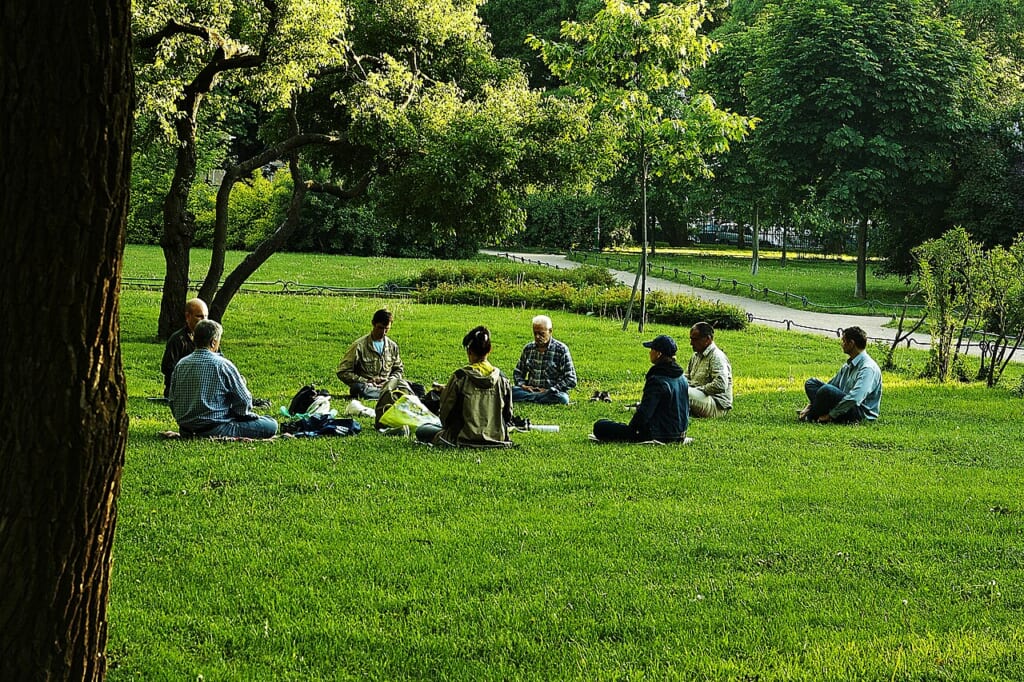
Cover photo: People gather in a park, sitting in yoga poses for a group meditation session. (Photo: Konstantin Stepanov from Moscow, Россия / CC BY 2.0 / Wikimedia Commons)
Information as of October 2026. For your own health, consult a doctor.
More from Senior Yoga Science (English)
- Yoga for older adults: better balance, but what about falls?
- Yoga for fear of falling: rebuilding confidence in later life
- Yoga for older adults: flexibility beyond the forward bend
- Yoga for older adults: leg strength and getting out of a chair
- Yoga for seniors and gait speed: what walking studies show
- Yoga for knee osteoarthritis: pain, stiffness and daily movement
- Yoga for chronic low back pain: moving better in later life
- Yoga for bone density after 60: what the research tells us
- Yoga for blood pressure in older adults: breathing and rest
- Yoga for older adults: what heart and blood vessel tests show
- Yoga and blood sugar after 60: what type 2 diabetes studies show
- Yoga for seniors and sleep: looking beyond hours in bed
- Yoga for older adults with depression: scores over 6 months
- Yoga for older adults: memory, attention and mental flexibility
- Yoga for MCI and dementia: memory, planning and daily life
- Yoga for older adults and loneliness: finding social connection
- Yoga and quality of life after 60: modest gains, with limits
- Yoga breathing for seniors: what lung function studies show
- Yoga for a rounded upper back after 60: what changed in trials
- Chair yoga for seniors: pain, walking and staying with it
- Yoga for frailty in older adults: walking, strength and limits
- Yoga for urinary incontinence: evidence for older women
- Yoga for older adults: how often to practice and keep going
- Yoga for Parkinson’s disease: movement and mood in later life
- Yoga for older cancer survivors: fatigue, sleep and daily life
- Yoga for neck and shoulder pain: what older adults should know
- Yoga safety for older adults: injuries, pain and safer practice
- Yoga for older adults compared with tai chi and walking
- Hot yoga for older adults: choosing a room that suits you
All Senior Yoga Science articles (English)
初日の汗は、予約した人だけが持ち帰れる。
2