

One railway line and one boundary linking Tachikawa and Fussa
The ties between Fussa and Tachikawa are not only the base.
The Ome Line starts at Tachikawa Station. According to Fussa City, Fussa Station on the Ome Railway opened in 1894. According to the encyclopedia, the Ome Railway opened the line from Tachikawa to Ome on 19 November that same year, and Haijima, Fussa, Hamura, Ozaku and Ome stations opened on that day. In other words, Fussa Station has stood on the line running out of Tachikawa since the day it opened. Fussa City writes that in 1925 a bus between Fussa and Itsukaichi and the Itsukaichi Railway also began running, and Fussa became lively as the gateway to the Nishitama (western Tama) region. When the track reaching out from Tachikawa arrived, Fussa became the gateway to the west.
In the Showa era there was one more line than today. According to the encyclopedia, in 1930 the Itsukaichi Railway extended a line from Tachikawa to Haijima along a separate, roundabout route to the south of the Ome Line, and the two railways ran side by side between Tachikawa and Haijima. In 1944, at nationalisation, this Tachikawa–Haijima section was suspended as a non-essential line. The same year, the Ome Line between Tachikawa and Nakagami was double-tracked. In the middle of the war, one line disappeared and another grew fatter. After the war, in 1949, a morning through train from Ome to Tokyo began running. From Fussa, through Tachikawa, to Tokyo. On the route linking the base town and the city centre, Tachikawa was always there.
Then and now
- Then (1943): at the temporary stop at Ushihama, only military personnel with season tickets could get a ticket. Now: on the day of the Japanese-American Friendship Festival, Ushihama Station overflows with crowds.
- Then (1950s and 1960s): American military families lived in the white bungalows. In the mid-1970s, young people drawn by the low rents moved into the empty houses. In the business magazine article, someone who knew that era recalls that the Fussa of those days was full of an American culture that was still unfamiliar in Japan. Now: the surviving houses are cafés and photo studios, and the tourism association recommends them as places for souvenir photos.
- Then (1969): transport planes took off from Tachikawa’s runway and moved to Fussa. Now: the lawns of a park spread over the Tachikawa site, and Fussa’s runway, still 3,350 metres, is part of a base used jointly by Japan and the US.
Older readers may remember looking up at English signs in front of Tachikawa Station. For younger readers that is a hard scene to imagine. The continuation of that scene still lies a dozen or so minutes up the Ome Line.
Let me sum up the base ties once more. Yokota Air Base was born in 1940 as an annex of the former Army Tachikawa Airfield. At the end of 1969, as flying stopped at Tachikawa Air Base, C-130 airlift units and others moved to Yokota. And even today, 0.29 square kilometres of Yokota’s land is in Tachikawa City. Tachikawa’s airfield gave birth to a child in Fussa, entrusted its own planes to that child late in life, and itself became a park. Read as a parent-and-child story, perhaps this is a little too sentimental. But line up the documents and it is hard to read it any other way.
The sentence in Fussa City’s chronology that held my eye longest was this one: “From around 1962, serious thought was given to shedding the image of a base town; that year the area was designated an urban development zone under the National Capital Region Development Act, and city planning went ahead.” A town that had grown with the base tried to become more than a base town. Then, on 1 July 1970, with a population of 38,749, the town of Fussa became Fussa City. Today the city counts up its facilities for daily life one by one: civic hall, library, gymnasium, parks, sewers.
Tachikawa did the same. After its base was returned, it put parks, a library and government offices on the land. Tachikawa after its base was gone, Fussa with its base still there, have each been trying to become “a town that is more than a base.” The difference between them is whether the fence is still standing; the direction they are heading in may be closer than you’d think.
When you finish walking Route 16 and turn around, there is a wide sky beyond the fence. On the map, the edge of that sky still connects to Tachikawa City.
The quiz answer
The answer is (B). According to the history of Ushihama Station collected in the encyclopedia, as military facilities went up one after another around Tama Airfield, the army ordered a temporary stop to be opened in haste, and it dealt only with military personnel holding season tickets. It opened on 1 March 1943. Today anyone can use it, and on the day of the annual Japanese-American Friendship Festival, crowds head from this station to the base’s Gate 5.
初日の汗は、予約した人だけが持ち帰れる。
Before you go
- From Tachikawa Station: take the JR Ome Line to Haijima (about 12 minutes by rapid train, according to Ishikawa Brewery). After Haijima comes Ushihama, then Fussa. According to the encyclopedia, the Route 16 shopping street and the base are about 600 metres east of Ushihama Station. Gate 2 of the base is on the east side of Fussa Station. Check train times on JR East’s information.
- From Shinjuku: take the JR Chuo Line to Tachikawa and change to the Ome Line there.
- Carry an IC card such as Suica or PASMO for the trains.
- How to walk it: head east from Ushihama Station and, when you reach Route 16, walk north or south along the fence. According to the tourism association, the shopping street runs 1.6 kilometres north to south. Back on the west exit side of Fussa Station are the shopping streets where the Tanabata festival is held.
- Inside the base: normally closed to the public. Always check the dates of open days such as the Japanese-American Friendship Festival, and the entry conditions (showing ID, bag checks and so on), in that year’s official announcements and Fussa City’s information. There are rules about photographing and entering the base; follow them.
- Fussa City, “Yokota Air Base (Overview)”: https://www.city.fussa.tokyo.jp/municipal/yokotabase/outline/index.html
- Fussa Tourism Association (event calendar, Yokota Air Base Story): https://www.fussakanko.jp/
- American houses are private homes or businesses; look and take photos from the street, and don’t go onto the property.
- To combine: walk from the east of Fussa westward towards the Tama River and you come to two sake breweries that have been running since the Edo period (see this series’ “Fussa sake breweries and the Tama River”). Back in Tachikawa, to trace the base’s history from Tachikawa’s side, the materials at the Tachikawa City Museum of History and Folklore and the Central Library are a good starting point (see “Tachikawa Air Base and Sunagawa” in this series).
Back from the base town: Tachikawa Station North Exit
Because the fence runs along one side of Route 16, there are stretches where the scenery barely changes however far you walk. Before you know it, your legs are more tired than you expected. By the time the Ome Line brings you back to Tachikawa, your calves will be carrying the full 1.6 kilometres, there and back.
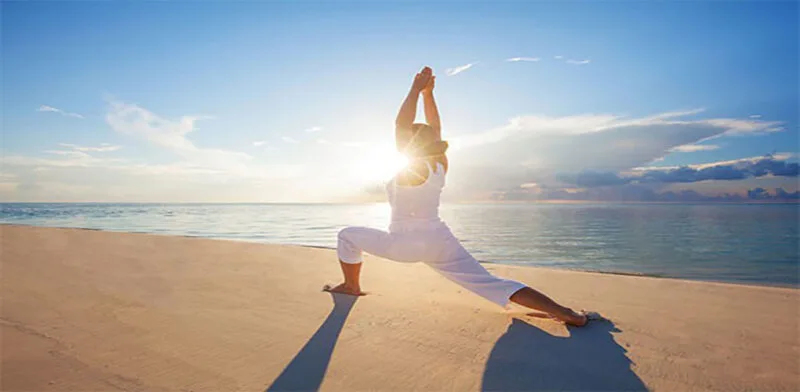
A one-minute walk from the North Exit of Tachikawa Station, on the 3rd floor of the Etoile Building at 2-14-10 Akebonocho, Tachikawa, Tokyo, is On the Shore Tachikawa (オンザショア立川店), a hot yoga studio where classes are held on heated lava stone. There is also room-temperature yoga, Pilates, women-only kickboxercise, boxercise, HIIT and personal training, with more than 25 kinds of yoga lessons alone.
It is open every day from 8:00 to 23:30, so even if you walk Fussa until evening, there is still time to stop in on the way home.
A trial yoga lesson costs ¥1,980 (tax included), including rental of two bath towels, one face towel and a mat. You can drop in empty-handed. Pregnant guests cannot join the lava-stone hot yoga, but room-temperature maternity yoga is available. Many of our yoga instructors speak English, and the studio’s owner, Naomi Fujita, who holds Japan’s top English qualification (Eiken Grade 1) and a perfect TOEIC score and once worked as a translator and overseas interpreter at Nomura Securities, and who lived in Alaska for three years, often helps guests from the US bases in English herself (visitors from abroad have even left Google reviews about the care they received in English); if you would like an English-friendly lesson, just say so when you book.
Studio information: https://ontheshore.jp/ ; trial booking: https://site.locaop.jp/C0aVK?_src=hp
In front of Tachikawa Station, you remember where Fussa’s sky came from. The parent of that base was the town under your feet.
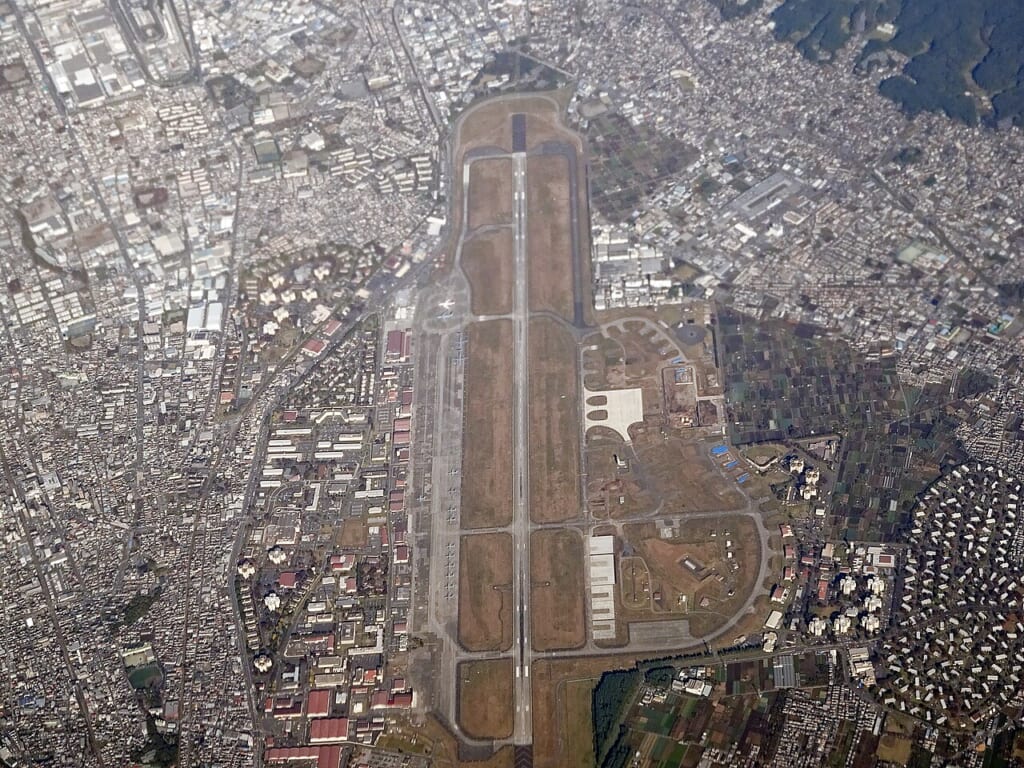
Cover photo: Yokota Air Base from the air, its north-south runway surrounded by Fussa and neighbouring towns. (Photo: ブルーノ・プラス / CC BY-SA 4.0 / Wikimedia Commons)
Information as of October 2026.
More Tachikawa Walks
- Tachikawa Air Raids: WWII History and a Memorial Walk Guide
- Tachikawa Autumn Leaves Guide: Ginkgo, Zelkova and Where to Walk
- Tachikawa Base Town History: Cola Bottles, Yuming, the Laundry Gate
- Tachikawa Air Base History Walk: The Sunagawa Struggle and After
- Tachikawa Sento Guide: Public Baths, Their History and Bath Etiquette
- Tachikawa Disaster Base and Life Safety Learning Center: A Guide
- Tachikawa Bridges Walk: ‘Nameless Bridge’ to a Double-Deck Crossing
- Tachikawa Cinema City Guide: Tokyo’s First Multiplex and Its Big Sound
- Tachikawa Museums Guide: Art, 2,558 Instruments and Things to Do
- Tachikawa Cycling Guide: Showa Kinen Park’s 14 km and the Tama River
- Tachikawa Festivals Guide: Bon Dances, Flamenco, Nebuta and Yokai
- Tachikawa History Walk: Famous People, from Seiji Ozawa to a Comet
- Tachikawa History Walk: Famous People Who Passed Through the Town
- Tachikawa Public Art Walk: A Guide to the 109 Works of Faret Tachikawa
- Tachikawa Farms Guide: Farm Stands, Harvest Days and Tokyo’s Fields
- Tachikawa History: Japan’s Firsts, from Electric Cars to Sazae-san
- Tachikawa Folktales and Legends: A History Walk Through Old Stories
- Tachikawa Walk: Fusai-ji Temple’s National Treasure and Suwa Shrine
- Tachikawa Business Guide: Where West Tokyo Works and Starts Up
- Tachikawa Culture Guide: Ballet, Ice, Anime and Art Near the Station
- Tachikawa’s Green Future: Zero Carbon, Farmland and Springs Guide
- Tachikawa for Foreign Visitors: Haneda Bus, Things to Do, Future
- Tachikawa Population and Family Life: A Guide to the Town’s Future
- Tama Monorail Extension: When It Opens and Tachikawa’s Future Guide
- Tachikawa and Tokyo’s Next Big Earthquake: Disaster Base Guide
- Showa Kinen Park Guide: The Future of Tachikawa’s Unfinished Park
- Tachikawa Station Redevelopment: A Guide to the Future Station Area
- Tachikawa’s Next Decade: Tachihi, GREEN SPRINGS and a New Hotel Guide
- Tachikawa GREEN SPRINGS Guide: Goats, a Rooftop River, Things to Do
- Tachikawa Travel Guide: Things to Do, Walks and History West of Tokyo
- Tachikawa Walk: Slopes, River Terraces and a Flat City’s Hidden Tilt
- Tachikawa History Walk: How a Mulberry Village Became Tama’s Hub
- Tachikawa Airfield History: The 2:12 a.m. Flight to London, 1937
- Tachikawa Was Once in Kanagawa: A History Walk to the 1893 Transfer
- Tachikawa Keirin Velodrome: History, Guide and the Grand Prix’s Home
- Tachikawa Childhood History: Candy Shops, a Base Christmas, Showa Kids
- Tachikawa Aviation Shrine History: The First ‘Tokyo Airfield’ Walk
- Showa Kinen Park Guide: Komorebi Village, Japanese Garden and Bonsai
- Tachikawa Libraries Guide: Raccoon Dogs, Lucky Cats, Local History
- Tachikawa Live Music Guide: Basement Venues and Where TM Meant Tama
- Tachikawa Manga Park Guide: 40,000 Manga in a Former City Hall
- Tachikawa Fireworks Festival Guide: History, Tips and Things to Do
- Akishima Day Trip from Tachikawa: Whale Fossil, Wisteria and History
- Fussa Sake Brewery Walk: Day Trip from Tachikawa, Water and History
- Hachioji Castle Ruins from Tachikawa: History Walk and Silk Town Guide
- Mount Takao Day Trip from Tachikawa: Hiking Guide, History and Forest
- Hino Day Trip from Tachikawa: Shinsengumi History Walk and Guide
- Kokubunji Walk from Tachikawa: Otaka-no-Michi Springs and History
- Kunitachi Walk from Tachikawa: Daigaku-dori, History and Yaho Tenmangu
- Mount Mitake Day Trip from Tachikawa: Wolf Shrine, Valley Walk Guide
- Ome Day Trip from Tachikawa: Showa Retro Walk, Things to Do, History
- Tachikawa Walk: Nekawa Green Path to the Tama River, a Riverside Guide
- Tachikawa Cat-Return Shrine Guide: History, Ema and Suitengu
- Tachikawa Night Views and Mount Fuji at Dawn: A Walking Guide
- Tachikawa at Night: Bar Alleys, Black Markets and Cinema History Walk
- Tachikawa Ramen and Udon Guide: Ramen Square and Noodle History
- Tachikawa vs. Central Tokyo: Why the West Side Wins on Space and Sky
- Tachikawa Old Villages Walk: History Guide, Shibasaki to Nishisuna
- Tachikawa Oni Park Guide: A Red Demon Slide and Trains for Kids
- Tachikawa Parks Guide: Things to Do Beyond Showa Kinen Park, a Walk
- Tachikawa Place Names: A History Walk Through Its Town-Name Origins
- Tachikawa Antarctic and Arctic Science Museum: Free Guide and History
- Tachikawa on a Rainy Day: Indoor Things to Do, a Local Guide
- Tachikawa History Museum Guide: Local History and Folklore, Free
- Tachikawa Cherry Blossoms Guide: Where to See Sakura, and the History
- Tachikawa Schools Walk: History of Night Classes, Bells, Antarctica
- Tachikawa Filming Locations Guide: Anime Pilgrimage and TV Dramas
- Tachikawa Silk History Walk: Japan’s No.1 Mulberry Village, Sunagawa
- Tachikawa Shopping Guide: Why It Has Everything, a History Walk
- Showa Kinen Park, Tachikawa: A Walking Guide to Highlights and History
- Tachikawa and San Bernardino: The History of Tokyo’s First Sister City
- Tachikawa Souvenirs Guide: What to Buy, from Tokyo Sake to Paper
- Tachikawa Sports Guide: Things to Do for Fans, Runners and Walkers
- Tachikawa Station Guide: The History Walk of Tama’s Busiest Station
- Tachikawa in Summer: Things to Do, Water Play and Heat Tips Guide
- Tachikawa Sun Sun Road Walk: History, Festival and Winter Lights
- Tachikawa Tachihi History Walk: Aircraft, a Beach and Things to Do
- Tachikawa History: The Samurai Clan Behind the City’s Name, a Walk
- Tama Monorail from Tachikawa: A Guide to Views, Mt. Fuji and History
- Tachikawa Tama River History Walk: Floods, Ferries and Bridges
- Tachikawa Walk: Tamagawa Aqueduct and Sunagawa History Guide
- Tachikawa Udo Guide: History of Tokyo’s Underground White Vegetable
- Tachikawa Trains Guide: Railway History and Where to Watch Trains
- Tachikawa Water History: Where the Tap Water Comes From, and Wells
- Tachikawa History: Why Tokyo’s First IKEA and Cinema Complex Came Here
- Tachikawa Wildlife Guide: Birdwatching, Fireflies and Tanuki Walks
- Tachikawa Yagawa Green Space Walk: Springs, Hake Cliffs and History
- Tachikawa from Yokota Air Base: A Weekend Guide and Things to Do
初日の汗は、予約した人だけが持ち帰れる。

