

Short periods of rest and everyday yoga offer different evidence
A study focusing on yoga nidra examined what happened immediately after a single session. It involved 32 adults with hypertension, with a mean age of 43: 22 men and 10 women. Participants received regular medical consultation and medication, and completed a 16-minute yoga nidra session. Their blood pressure was measured before and afterward. Systolic pressure fell by 7 mmHg and diastolic pressure by 6 mmHg, with statistically significant changes.[8] This was a single-session before-and-after study without a comparison group, and its participants were not exclusively older adults.
The study also measured heart rate variability, meaning variation in the intervals between heartbeats. Measures of variability increased after the session, and researchers analyzed the relationship between those changes and changes in blood pressure.[8] This gives the study a focus beyond the monitor’s two blood pressure values. It examined changes around a rest-based practice and explored how the measurements related to one another. The finding is part of the interest in yoga that does not require substantial movement.
Its time frame is different from the older-adult trial described earlier. One study took measurements immediately around 16 minutes of practice; the other assessed outcomes after 24 weeks of adding guided breathing and meditation to usual treatment.[7][8] Both are worth reading, but they answer different questions. For a reader considering yoga nidra, the single-session study provides a specific example of the activity and duration investigated. The longer trial provides evidence about continuing a home-based intervention alongside treatment in older adults.
Everyday yoga has also been studied through medical records. A retrospective observational study compared 1,815 records from 1,355 people who practiced yoga with 40,326 records from 8,682 people who did not. The records were collected between 2006 and 2016. Yoga participants had a median age of 46, 87.8% were women, and 62.3% practiced once a week.[9] This was a study of yoga as people used it in daily life, rather than a trial assigning everyone a standardized program.
Yoga participation was associated with systolic pressure that was 2.8 mmHg lower and diastolic pressure that was 1.5 mmHg lower. The authors reported that effect sizes depended on age.[9] The association is interesting because it concerns an existing habit in ordinary life. The participants were not randomly assigned to yoga, so the difference cannot establish yoga alone as its cause.[9] This study contributes a different kind of evidence from trials that deliberately introduce a practice and compare assigned groups.
初日の汗は、予約した人だけが持ち帰れる。
Comparisons with other activity showed smaller or absent differences
The comparison group changes the meaning of a result. In the 2025 review, blood pressure was lower with yoga than with waiting-list controls, but the findings changed when yoga was compared with active controls doing another activity. Across 5 trials involving 306 participants, the systolic mean difference was −4.16 mmHg, with a 95% confidence interval from −10.76 to 2.44 mmHg. There was no statistically significant systolic difference.[2]
For diastolic pressure in the same active-control comparison, the mean difference was −1.88 mmHg, with a 95% confidence interval from −3.41 to −0.36 mmHg. That difference was statistically significant.[2] The review therefore had different findings for the two blood pressure numbers: a significant diastolic difference and no significant systolic difference.
The 2013 analysis likewise found a reduction when yoga was compared with no added treatment, but no significant reduction when it was compared with exercise.[5] If you already enjoy an activity and continue it, this finding gives no reason to abandon it solely to switch to yoga for blood pressure. Yoga can broaden the available choices. Its breathing and rest components may make it an appealing activity to discuss, while the research comparison with exercise keeps claims of superiority in proportion.
The quality assessments also matter. The 2025 review rated the evidence very low quality and reported substantial variation between studies.[2] The 2022 review found low methodological quality, largely because of inadequate reporting.[4] All 17 studies in the 2013 analysis had unclear or high risk of bias.[5] The direction of the findings is encouraging, and the need for larger, rigorous trials is shared across the reviews.[2][4][5] This is the main uncertainty around estimating the size of yoga’s benefit.
Smaller studies in older populations add practical descriptions without resolving that uncertainty. In Vietnam, 30 women aged 60–74 participated in yoga for 60 minutes per session, 3 times a week, over 6 months. Improvements in blood pressure and physical fitness were reported, but no control group was described.[10] The age range, session length, frequency and duration make the report useful when discussing a possible longer routine. The absence of a comparison group leaves the cause of the improvement uncertain. Blood pressure findings also do not explain whether participants found stairs easier or experienced fewer falls; those movement outcomes deserve their own evidence.
Another small before-and-after study involved 19 people aged 50–70. Average systolic pressure fell from 148.53 to 141.53, and average diastolic pressure from 93.26 to 87.37, using the figures as reported in the paper. The differences were statistically significant.[6] The study measured the same people before and after, without a separate control group, and did not exclusively recruit people over 60.[6] Its larger-looking change is therefore no basis for ranking its approach above the older-adult randomized trial.
There is also a trial plan for adults aged 65 and over, adding online yoga to usual treatment twice a week, for either 20 or 40 minutes per session, over 10 weeks. Results demonstrating a blood-pressure-lowering effect have not yet been reported.[15] The planned schedule is an example of a question being investigated, rather than a demonstrated benefit.

Common misconceptions
One misconception is that more poses must produce a larger blood pressure benefit. Studies examining the structure of practice point elsewhere. Many interventions that improved pressure included time for breathing, meditation or relaxation as well as postures. Interventions without improvement tended to emphasize postures and spend longer on them.[4] A better question for choosing a session is whether it contains both movement and quiet breathing or rest. Heat and yoga in older adults are covered separately in the article in this series devoted to that topic.
A second misconception is that breathing practice can replace blood pressure medication. The older-adult home trial compared usual treatment with usual treatment plus breathing and meditation.[7] Its evidence supports an addition to care. Keep medication decisions with the treating doctor rather than changing prescriptions yourself because you have started yoga. The relevant conversation brings the current treatment and the proposed practice together, matching the relationship between them in the study.
A third assumption is that lower systolic pressure in these studies means fewer heart or blood vessel diseases were demonstrated. The major outcomes discussed here were blood pressure; the older-adult trial also evaluated sleep quality.[2][7] A change in blood pressure and a change in the number of disease events are different outcomes. The measured benefit is worth taking seriously on its own terms, without adding a future effect the studies did not establish.
Adult children can use that precision in conversations with a parent. A helpful description is that older adults have been studied practicing breathing and meditation at home while continuing their treatment.[7] It introduces an activity without comparing how fit different people are or promising a specific result. The older person’s interest, the guidance needed, and the discussion with their doctor can then become part of the same decision. The evidence is a starting point for choosing a habit, rather than pressure to perform one.
What you can do today
- If you have a chronic condition or take medication, consult your treating doctor before starting. If you take blood pressure medication, watch for lightheadedness when rising from the floor or coming up from a forward bend, and rise slowly. Keep breathing rather than holding your breath, and check prolonged head-down positions with your doctor and instructor. Stop if you feel dizzy or unsteady, and do not continue through pain.
- Within the limits your doctor approves, consider instructor-taught yoga using the schedule studied in women aged 60–74: 60 minutes per session, 3 times a week for 6 months. Agree suitable movements and an achievable starting duration with your doctor and instructor; the study schedule is not an initial target everyone should meet.[10]
- At home, consider a single 16-minute yoga nidra session after your doctor has approved it and you have learned the method. This was the single rest-based session studied in adults with hypertension, rather than a tested daily frequency or evidence of long-term effects in older adults. Continue breathing and stop if dizziness occurs.[8]
- If you want an approach that also addresses food, bring the 8-week study of weekly yoga and dietary practice to your doctor. Explain that it included education, a handbook and home visits, and discuss diet and family support as part of the proposed routine.[1]
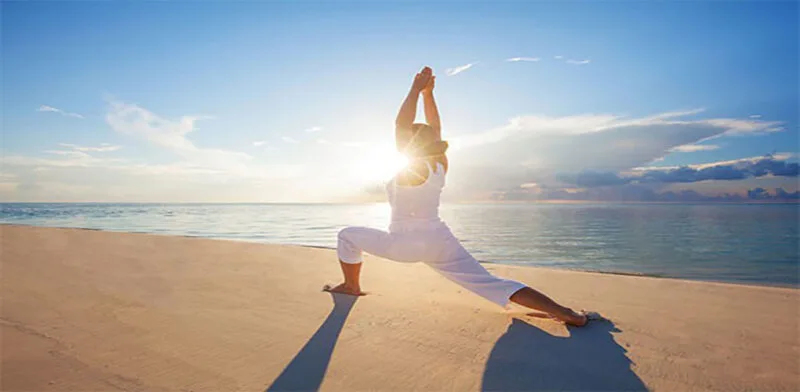
Make time for breathing and rest at On the Shore Tachikawa
For a blood pressure routine that includes breathing and rest, consider a fixed weekly time to keep moving at On the Shore Tachikawa (オンザショア立川店).
The studio is a 1-minute walk from the North Exit of JR Tachikawa Station, at 3F Etoile Building, 2-14-10 Akebonocho, Tachikawa, Tokyo. It is open every day from 8:00 to 23:30. Many of our yoga instructors speak English, and the studio’s owner often helps guests from the US bases in English herself.
Older guests should start with room-temperature yoga. Anyone sensitive to heat or with a chronic condition should check with their doctor first. Guests told by a doctor not to exercise cannot join. Pregnant guests cannot participate in lava-stone hot yoga.
On the Shore is a lava-stone hot yoga studio with more than 25 kinds of yoga lessons, including room-temperature yoga. It also offers Pilates, women-only kickboxercise, boxercise, HIIT and personal training.
A 60-minute trial yoga lesson costs ¥1,980 including tax, with 2 bath towels, 1 face towel and yoga mat rental included. Consult the studio information, prices and trial booking page.
References
- Effects of a Yoga–DASH Diet program on blood pressure in older adults with hypertension in Bangkok Communities — Warissara Mangkalad et al., 2026, Journal of Public Health and Development. DOI: 10.55131/jphd/2026/240301
- A systematic review and meta-analysis of yoga for arterial hypertension — Christoph Geiger et al., 2025, PLOS One. DOI: 10.1371/journal.pone.0323268
- Content, Structure, and Delivery Characteristics of Yoga Interventions for Managing Hypertension: A Systematic Review and Meta-Analysis of Randomized Controlled Trials — G. Nalbant et al., 2022, Frontiers in Public Health. DOI: 10.3389/fpubh.2022.846231
- Effectiveness of Yoga for Hypertension: Systematic Review and Meta-Analysis — M. Hagins et al., 2013, Evidence-based Complementary and Alternative Medicine : eCAM. DOI: 10.1155/2013/649836
- The Effect of Yoga Exercise on Reducing Blood Pressure among Elderly with Hypertension — Aura Rosse Maharani et al., 2024, Journal of Epidemiology and Public Health. DOI: 10.26911/jepublichealth.2024.09.02.11
- Effect of Home-based Mobile Guided Pranayam and Yog Nidra Meditation on Blood Pressure and Sleep Quality of Elderly Hypertensive Individuals: A Randomised Controlled Trial — Akshita et al., 2025, Annals of Neurosciences. DOI: 10.1177/09727531251359827
- The Effect of Yoga Nidra Intervention on Blood Pressure and Heart Rate Variability Among Hypertensive Adults: A Single-arm Intervention Trial — Navdeep Ahuja et al., 2025, Cureus. DOI: 10.7759/cureus.77717
- Antihypertensive effects of yoga in a general patient population: real-world evidence from electronic health records, a retrospective case-control study — Nadia M. Penrod et al., 2022, BMC Public Health. DOI: 10.1186/s12889-022-12569-3
- The Effects of Long-term Yoga Program on Blood Pressure and Physical Fitness of Older Adults with Stage 1 Hypertension — Thuy Thi Nguyen et al., 2024, Annals of Applied Sport Science. DOI: 10.61186/aassjournal.1414
- CONTENT, STRUCTURE AND DELIVERY CHARACTERISTICS OF YOGA INTERVENTIONS FOR MANAGING HYPERTENSION: A SYSTEMATIC REVIEW AND META-ANALYSIS OF RANDOMISED CONTROLLED TRIALS — G. Nalbant et al., 2021, Journal of Hypertension. DOI: 10.1097/01.hjh.0000749216.98849.fd
- The effect of MediYoga on sleep-quality, blood pressure and quality of life among older people with hypertension: study protocol of a pragmatic randomized controlled trial — S. Risom et al., 2025, BMC Complementary Medicine and Therapies. DOI: 10.1186/s12906-025-04846-6
Cover photo: An electronic blood pressure monitor displays a systolic reading of 138 and diastolic reading of 73 mmHg. (Photo: Jacek Halicki / CC BY-SA 4.0 / Wikimedia Commons)
Information as of October 2026. For your own health, consult a doctor.
More from Senior Yoga Science (English)
- Yoga for older adults: better balance, but what about falls?
- Yoga for fear of falling: rebuilding confidence in later life
- Yoga for older adults: flexibility beyond the forward bend
- Yoga for older adults: leg strength and getting out of a chair
- Yoga for seniors and gait speed: what walking studies show
- Yoga for knee osteoarthritis: pain, stiffness and daily movement
- Yoga for chronic low back pain: moving better in later life
- Yoga for bone density after 60: what the research tells us
- Yoga for older adults: what heart and blood vessel tests show
- Yoga and blood sugar after 60: what type 2 diabetes studies show
- Yoga for seniors and sleep: looking beyond hours in bed
- Yoga for older adults with depression: scores over 6 months
- Yoga for seniors with anxiety: chair trials and stress signals
- Yoga for older adults: memory, attention and mental flexibility
- Yoga for MCI and dementia: memory, planning and daily life
- Yoga for older adults and loneliness: finding social connection
- Yoga and quality of life after 60: modest gains, with limits
- Yoga breathing for seniors: what lung function studies show
- Yoga for a rounded upper back after 60: what changed in trials
- Chair yoga for seniors: pain, walking and staying with it
- Yoga for frailty in older adults: walking, strength and limits
- Yoga for urinary incontinence: evidence for older women
- Yoga for older adults: how often to practice and keep going
- Yoga for Parkinson’s disease: movement and mood in later life
- Yoga for older cancer survivors: fatigue, sleep and daily life
- Yoga for neck and shoulder pain: what older adults should know
- Yoga safety for older adults: injuries, pain and safer practice
- Yoga for older adults compared with tai chi and walking
- Hot yoga for older adults: choosing a room that suits you
All Senior Yoga Science articles (English)
初日の汗は、予約した人だけが持ち帰れる。
2


