

Adding yoga to existing support changes the question
In a 2025 randomized controlled trial of 56 community-dwelling adults aged 60–80 with balance impairments or fear of falling, both occupational therapy alone and occupational therapy plus yoga improved balance and gait scores over 12 weeks, with greater improvements in chair balance, standing balance, walk initiation and step characteristics in the combined group; the companion feature on fear of falling discusses this study further.[15]
For readers already receiving rehabilitation, the comparison is about adding yoga to support for daily activities. Keep prescribed treatment and rehabilitation going, and discuss how an additional activity would fit with that care.[15]
Research comparing yoga with another exercise program also found a divided picture. In a study of 35 adults over 65, yoga participants scored higher than the exercise group on lower-body flexibility, and higher than the no-program group on right-leg static balance, while the exercise group scored higher in some areas of quality of life.[14] That comparison deserves the same fair reading as any other: different programs may show strengths in different outcomes. The companion feature on fear of falling explores the psychological side in more detail.
Bartos and colleagues assessed physical and psychological outcomes separately. The physical measures included lower-body strength, static balance and lower-body flexibility; the psychological measures included perceived self-efficacy concerning falls and health-related quality of life. Yoga participants scored higher on both right and left lower-body flexibility tests than participants in either of the other groups. The exercise group’s advantages over yoga concerned the Energy/Fatigue, Pain and General Health subscales of the RAND-36 questionnaire.[14]
These results give a more specific picture than a single overall ranking of the programs. Flexibility, balance on the right leg and the questionnaire subscales describe different findings. Keeping the comparison group attached to each result preserves what this small study of 35 community-dwelling adults actually found.[14]
Together, these studies encourage a practical question about program content. Is the proposed activity standing-posture practice, a mixed yoga program or yoga added to therapy? The outcomes reported in each study belong to that particular arrangement.[6][7][15] Matching the question to the program makes the research more useful when deciding what to continue, what to add and what to discuss before joining a class.
初日の汗は、予約した人だけが持ち帰れる。
Better balance and fewer falls have different evidence
After reviewing the movement benefits, the central uncertainty becomes clearer: what happened to the number of falls? The 2024 review reported mixed findings for falls and fear of falling despite its favorable balance findings. Yoga styles, intervention durations and assessment methods varied substantially.[2] These differences make a single promise about yoga and falls a poor fit for the research.
The large 2025 SAGE trial supplies an unfavorable result that must remain part of the picture. In people aged 60 and over, the fall rate was higher with an Iyengar yoga-based exercise program than with seated yoga relaxation; the conclusion was that this exercise program should not be recommended for fall prevention.[3] It is a direct reminder that improvements in a balance test and outcomes in everyday falls can point in different directions.
A different trial reported fewer falls in a particular clinical population. The 2024 randomized controlled trial enrolled 128 people aged 60 and over with osteoarthritis of the knee or hip. Participants received either a traditional Indian yoga-based exercise program or standard care. Yoga sessions lasted 60 minutes, 3 times a week, for 12 weeks.[11] The joint condition is central to understanding this result.
At 12 weeks, the yoga group had better Berg Balance Scale scores, with a between-group difference of 5.9 points. The Timed Up and Go test, an assessment of getting up and walking, favored yoga by −2.3 seconds.[11] Both the balance score and the movement time therefore improved in the same trial, alongside the measurement of actual fall incidence.
The incidence rate ratio for falls was 0.56, indicating a lower rate in the yoga group than in the standard-care group, although the published summary reports no confidence interval for that ratio. Improvements were largely maintained at the 24-week follow-up.[11] This is a favorable result for the people and program studied, including both movement and falls rather than movement tests alone.
Assessments took place at baseline and at 6, 12 and 24 weeks. Researchers also measured pain intensity, osteoarthritis symptom scores and fear of falling. These outcomes improved significantly in the yoga group.[11] For participants living with a joint condition, the study followed symptoms and movement within the same program, rather than separating the balance result from everything else they experienced.
That favorable clinical trial sits beside a less consistent review focused on older women. The 2025 systematic review found inconsistent effects on balance, gait and lower-limb strength. It concluded that a definitive effect on fall prevention in older women had not been directly established.[10] The participant group matters: a broad account of older adults can conceal differences that become visible when the evidence is examined for women specifically.
The comparison groups also differ across studies. The pilot compared standing-posture yoga plus education with education alone; the osteoarthritis trial compared yoga with standard care; SAGE compared an exercise program with seated yoga relaxation.[3][6][11] Knowing what the other group did helps explain the question each trial answered. “Compared with what?” is as useful as “Which yoga?” when reading a headline about benefit.
More seconds on a balance test are not fewer falls on a calendar. The evidence offers measured benefits for balance and movement, and conflicting results for actual falls.[2][3][4][6][10][11] Keeping that distinction visible allows a reader to value the movement findings while taking a history of falls or unsteadiness seriously when deciding how to begin.
Common misconceptions
“If yoga improves my balance, I will stop falling.” The older-adult meta-analysis found improvements in balance and mobility, and its authors called for further research to determine whether those improvements translate into preventing falls.[4] The SAGE result makes that unanswered step especially concrete.[3] A useful personal goal can concern movement, while decisions about fall prevention still need to account for the conflicting falls evidence.
“Longer or more frequent practice must work better for falls.” The schedules here include twice weekly for 12 weeks, 30 minutes daily for 4 weeks and 60 minutes 3 times weekly for 12 weeks.[5][6][11] The populations and program contents differ. Ranking their schedules by amount of practice does not turn them into a study that varied only the dose, and the most demanding schedule is not an established starting target for a beginner.
“Breathing exercises alone should produce the same standing-balance result.” The meta-analysis of adults aged 60 and over excluded interventions consisting only of meditation and breathing.[4] Its conclusions therefore concern physical yoga. Breathing and meditation were part of the mixed program in Shete’s study, alongside preparatory exercises and postures.[7] When reading about a benefit, ask what participants actually practiced and whether that resembles the activity you are considering.
It also helps to state which change matters most to you. Standing more securely, rising from a chair, feeling less afraid and having fewer falls are different outcomes in these studies.[3][6][7][11] For an adult child helping a parent choose an activity, naming the concern creates a clearer conversation with the instructor or clinician than asking for yoga that helps with everything. The separate feature on fear of falling addresses the emotional outcome in more depth.
What you can do today
- If your clinician and instructor consider participation appropriate, begin supervised physical yoga in an environment with support available. The comparative study used 30 minutes daily, or 7 days a week, for 4 weeks. Use that as a research example when planning suitable practice, with the content matched to your ability; do not strain to complete the study’s time target.[5]
- If you have knee or hip osteoarthritis and your doctor approves exercise, discuss supervised physical yoga that can accompany your treatment. The trial used 60-minute sessions 3 times a week for 12 weeks. Confirm suitable content before starting and stop any movement that causes pain.[11]
- If you have fallen, feel unsteady, have a chronic condition or take medication, consult your doctor before starting and tell the instructor the conditions set for exercise. Do not practice through pain. For standing work, choose a setting with a wall or chair within reach, and avoid trying an eyes-closed single-leg balance test at home.[6]
- Keep a record of attendance and any pain or unsteadiness. In the twice-weekly, 12-week trial, participants attended an average of 20 of 24 classes. At the end of an agreed practice period, review changes in getting up and making short movements with the instructor, alongside how comfortably you participated.[6]
Give balance practice a weekly place at On the Shore Tachikawa
Practicing the standing and movement skills discussed here starts with finding a fixed weekly time to keep moving.
On the Shore Tachikawa (オンザショア立川店) is a lava-stone hot yoga studio at 3F Etoile Bldg, 2-14-10 Akebonocho, Tachikawa, Tokyo, a 1-minute walk from the North Exit of JR Tachikawa Station. It is open every day from 8:00 to 23:30, providing a schedule to consider alongside your weekly commitments.
For older guests, room-temperature yoga is the starting option to consider. Check with your doctor before joining if you are sensitive to heat or have a chronic condition. Anyone whose doctor has prohibited exercise cannot participate. Pregnant guests cannot join lava-stone hot yoga.
Many of our yoga instructors speak English, and the studio’s owner often helps guests from the US bases in English herself. The studio offers more than 25 kinds of yoga lessons, including room-temperature yoga. Pilates, women-only kickboxercise, boxercise, HIIT and personal training are also available.
The 60-minute yoga trial costs ¥1,980 including tax and includes 2 bath towels, 1 face towel and mat rental. Read the studio information and prices, and compare the lesson information with your doctor’s exercise conditions before booking a trial.
References
- Effect of yoga on balance, falls, and bone metabolism: a systematic review of randomized controlled trials in healthy individuals — P. Bajaj et al., 2024, Osteoporosis International. DOI: 10.1007/s00198-024-07307-x
- The effect of an Iyengar yoga-based exercise programme versus a seated yoga relaxation programme on falls in people aged 60 years and older (SAGE): a pragmatic, two-arm, parallel randomised controlled trial. — Juliana S. Oliveira et al., 2025, The lancet. Healthy longevity. DOI: 10.1016/j.lanhl.2025.100749
- Yoga-based exercise improves balance and mobility in people aged 60 and over: a systematic review and meta-analysis. — S. Youkhana et al., 2015, Age and ageing. DOI: 10.1093/ageing/afv175
- Yoga Exercise Intervention Improves Balance Control and Prevents Falls in Seniors Aged 65+ — M. Krejčí et al., 2022, Slovenian Journal of Public Health. DOI: 10.2478/sjph-2022-0012
- A 12-week Iyengar yoga program improved balance and mobility in older community-dwelling people: a pilot randomized controlled trial. — A. Tiedemann et al., 2013, The journals of gerontology. Series A, Biological sciences and medical sciences. DOI: 10.1093/gerona/glt087
- Effect of Yoga Practices on Postural Stability, Fall Risk, and Psychological Wellbeing in Older Adults — S. Shete et al., 2026, Geriatrics. DOI: 10.3390/geriatrics11010016
- The Effects of Yoga on Fall-Related Physical Functions for Older Women: A Systematic Review of Randomized Controlled Trials — Tzu-Chun Huang et al., 2025, Healthcare. DOI: 10.3390/healthcare13020124
- ASSESSING THE EFFECTIVENESS OF A TRADITIONAL INDIAN YOGA BASED EXERCISES PROGRAM IN IMPROVING BALANCE AND REDUCING FALLS AMONG ELDERLY PATIENTS WITH OSTEOARTHRITIS: A RANDOMIZED CONTROLLED TRAIL — Vijay Shankar, 2024, Journal of Population Therapeutics & Clinical Pharmacology. DOI: 10.53555/w6j3rq17
- Effectiveness of Yoga versus Exercise for Reducing Falling Risk in Older Adults: Physical and Psychological Indices — L. Bartos et al., 2022, Perceptual and Motor Skills. DOI: 10.1177/00315125221100820
- Effectiveness of Yoga along with Occupational Therapy Intervention on Balance and Gait in Older Adults — P. Bhama et al., 2025, International Journal of Health Sciences and Research. DOI: 10.52403/ijhsr.20250621
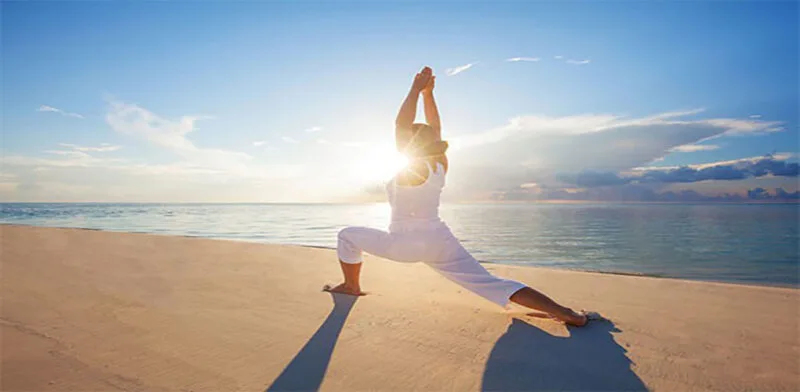
Cover photo: A person practices a standing Warrior I yoga pose outdoors in the morning sunlight. (Photo: Jarek Tuszyński / CC BY-SA 3.0 / Wikimedia Commons)
Information as of October 2026. For your own health, consult a doctor.
More from Senior Yoga Science (English)
- Yoga for fear of falling: rebuilding confidence in later life
- Yoga for older adults: flexibility beyond the forward bend
- Yoga for older adults: leg strength and getting out of a chair
- Yoga for seniors and gait speed: what walking studies show
- Yoga for knee osteoarthritis: pain, stiffness and daily movement
- Yoga for chronic low back pain: moving better in later life
- Yoga for bone density after 60: what the research tells us
- Yoga for blood pressure in older adults: breathing and rest
- Yoga for older adults: what heart and blood vessel tests show
- Yoga and blood sugar after 60: what type 2 diabetes studies show
- Yoga for seniors and sleep: looking beyond hours in bed
- Yoga for older adults with depression: scores over 6 months
- Yoga for seniors with anxiety: chair trials and stress signals
- Yoga for older adults: memory, attention and mental flexibility
- Yoga for MCI and dementia: memory, planning and daily life
- Yoga for older adults and loneliness: finding social connection
- Yoga and quality of life after 60: modest gains, with limits
- Yoga breathing for seniors: what lung function studies show
- Yoga for a rounded upper back after 60: what changed in trials
- Chair yoga for seniors: pain, walking and staying with it
- Yoga for frailty in older adults: walking, strength and limits
- Yoga for urinary incontinence: evidence for older women
- Yoga for older adults: how often to practice and keep going
- Yoga for Parkinson’s disease: movement and mood in later life
- Yoga for older cancer survivors: fatigue, sleep and daily life
- Yoga for neck and shoulder pain: what older adults should know
- Yoga safety for older adults: injuries, pain and safer practice
- Yoga for older adults compared with tai chi and walking
- Hot yoga for older adults: choosing a room that suits you
All Senior Yoga Science articles (English)
初日の汗は、予約した人だけが持ち帰れる。
2


