
Cycling trials include fat loss and no change
Intervention trials can test the associations suggested by surveys more directly. In this randomized trial, chance determined which of 4 groups each participant joined: 130 younger, physically inactive women and men with overweight or obesity were assigned to habitual lifestyle, cycling to work, moderate-intensity leisure exercise or vigorous-intensity leisure exercise. Their BMI was 25–35, and the intervention lasted 6 months.[11]
The main outcome was change in fat mass measured by DXA. Compared with the habitual-lifestyle control group, the cycling group had a difference in fat mass of −3.6 kg at 3 months and −4.2 kg at 6 months. The 95% confidence interval for the 6-month difference was −6.6 to −1.9 kg. This was an outcome for measured fat mass, rather than simply a change in the number displayed on a scale.[11]
At 6 months, the moderate-intensity leisure exercise group had a fat-mass difference of −2.6 kg compared with controls, while the vigorous-intensity group had a difference of −4.5 kg. Fat loss was greater in the vigorous group than in the moderate group, with a difference of −1.8 kg. The trial provides more direct evidence than a cross-sectional survey that exercise built into commuting can change fat mass under the conditions studied.[11]
It does not establish that riding your usual route will remove 4.2 kg of fat. That number is a comparison with a control group, and the participants were younger people with low physical activity and overweight or obesity. The abstract does not provide enough information about commuting distance, speed and implementation to reproduce an identical prescription for every reader. The label “cycling to work” is broader than the complete intervention that produced the result.[11]
There is also a completion detail to keep in view: 90 participants completed testing at 6 months. Not everyone randomized was measured at the final visit. That belongs alongside the favorable outcome when considering the study, rather than disappearing behind the headline. A useful interpretation preserves the population, duration, outcome measure, comparison and uncertainty together. Removing those conditions changes the meaning of the result.[11]
A different randomized cycling trial involved 26 healthy men and women aged 20–55, with BMI no higher than 30. It lasted 10 weeks, and the cycling group averaged 148 minutes of commuter cycling per week. A measure of aerobic fitness improved, but researchers found no change in weight or body fat. This is an unfavorable result for someone whose main goal is weight loss, even though it contains other favorable findings.[13]
The cycling group’s average weight was 78.5 kg at the start and 78.7 kg at the end. DXA-measured body fat was 29.4% before and 29.5% afterward. Weight changes over time and differences between groups were not significant. Skinfold measurements likewise indicated that body fat was maintained. Weekly activity logs found no group difference in total physical activity, although combined moderate and vigorous activity was greater in the cycling group.[13]
The trials differed in duration, participants’ activity and body size, and sample size. Listing those differences does not prove which one explains the contrasting fat outcomes. In particular, we cannot conclude simply that the shorter study would have produced fat loss if it had continued longer. The defensible conclusion is that interventions sharing the name “commuter cycling” do not necessarily produce the same body-composition result.[11][13]
This distinction is useful when a new cycling routine leaves your weight unchanged. A change in exercise and a change in weight need not be the same event. The smaller trial reported improvements in some cardiovascular measures despite unchanged body composition. At the same time, its findings do not justify explaining every unchanged scale reading as hidden muscle gain or fat loss. In that trial, the body fat measurements themselves did not show a reduction.[13]
初日の汗は、予約した人だけが持ち帰れる。
Walking and stairs answer different questions
Walking findings are also mixed. A British longitudinal study of 809 people used self-reported commuting, height and weight to examine both maintaining walking or cycling and changing the time spent in these activities. Maintaining cycling was initially associated with lower BMI, but the association was no longer significant after accounting for starting BMI. Maintaining walking was not significantly associated with BMI either.[3]
When the analysis was restricted to people who did not move home, increased walking time was associated with lower BMI: the difference was 0.32, with a 95% confidence interval of 0.03–0.62. Other changes in time spent walking or cycling were not significantly associated with BMI change. The favorable walking result therefore came with a specific condition. Selecting it alone would make the overall findings look more consistent than they were.[3]
The effect of accounting for starting BMI is a useful lesson in reading evidence. If people cycling at the beginning are lighter later, that may reflect a difference already present when the study began. It is not automatically evidence that continuing to cycle changed their weight during follow-up. Separating an existing difference from a subsequent change helps explain why a plausible commuting habit can have less certain weight evidence than its reputation suggests.[3]
A Finnish study provides a different kind of information. It followed 1,357 adults and used questionnaires alongside pedometers or accelerometers, BMI and waist measurements. Active commuters took an average of 953–1,345 more steps per day than passive commuters. Walking and public transport users recorded more steps than car users in both summer and winter. Here, the question includes whether the travel habit is associated with more movement across the day.[7]
People switching to active commuting had an increase in daily steps 763 greater than people who stayed passive commuters. Across 11 years, BMI and waist circumference increased, but the BMI increase among people maintaining active commuting was 0.4 smaller than among people maintaining car commuting. Again, more steps and less weight gain are related findings, but these data do not supply a formula converting the extra steps into calories burned or kilograms lost.[7]
Stair climbing has yet another evidence base. A cross-sectional analysis involved 782 men and women from the Dutch Famine Birth Cohort, with an average age of 58.3. Participants were asked whether they climbed stairs daily. Researchers examined the association with metabolic syndrome, a combination of factors involving abdominal obesity, blood glucose, blood pressure and blood lipids. The odds among those not climbing stairs daily were 1.90 relative to those who did, with a 95% confidence interval of 1.23–2.92.[17]
That odds ratio is not a forecast that taking station stairs will reduce your chance of illness by a fixed amount. The analysis examined a same-time association, rather than testing whether commuting stairs prevented disease. The question was whether people climbed stairs daily; it did not specify steps, flights or minutes. The study cannot tell us how many stair climbs would produce a particular amount of weight loss.[17]
Choosing stairs at a station can still be a concrete way to place movement in a journey. The evidence here does not allow stair climbing and walking to work to be added together as interchangeable exercise doses. Bags, crowds, handrails and the condition of your knees belong in that decision. If symptoms or a medical condition affect whether exercise is appropriate, consult a doctor and give that advice priority over a study average.

Common misconceptions
“My train commute cannot count as movement.” Studies have associated public transport commuting with lower BMI than private transport commuting. Japanese follow-up research also found less weight gain among people maintaining active or public transport commuting than among inactive commuters. These results give reason to examine the journey to and from the station. They do not identify riding the train itself as the active ingredient.[2][5]
“Cycling must make you lose more weight than walking.” Cycling groups showed strong associations in a large survey, and one randomized trial found reduced fat mass. Another randomized trial found unchanged weight and body fat. A vehicle’s name cannot promise an outcome without specifying the people and conditions involved. The available results do not give every commuter a reliable ranking of travel methods by expected personal weight loss.[1][11][13]
“If I walked and gained weight, the effort failed.” Japanese and Finnish longitudinal studies reported average BMI increases even in the active commuting groups. The favorable finding was a smaller increase than in less active comparison groups. You cannot observe your own alternative life with a different commute, so these group comparisons cannot directly certify an individual success. They do show why weight loss and prevention of gain need separate consideration.[5][7]
The wider review reinforces that mixed picture. Among 30 studies examining active transport and body weight, 13 found associations in the expected direction for all or most outcomes, while 12 found some associations. Others included associations in opposing directions or found no associations. The review included 36 unique adult studies overall and concluded that evidence linking active transport with lower weight was limited. Variation in methods and the many cross-sectional designs hindered quantitative conclusions.[20]
In everyday terms, evidence does not choose the route for you. A safe sidewalk, a place to park a bicycle, an opportunity to change clothes after arrival, rain and heavy bags can all affect what is feasible. Checking those conditions is part of turning a promising category into an actual journey. The practical starting point is a route you can use, followed by checking whether you used it, rather than attaching a study’s average weight change to an untested plan.
What you can do today
- If you commute by train, walk 1 safe stretch between home and the station or between the station and work on your next working day. If that stretch fits your route, maintain it on working days. Longitudinal studies associated maintained active or public transport commuting with less BMI gain; they did not establish a prescribed walking duration.[5][7]
- If you drive, walk a safe stretch from your parking place to work on 1 working day this week. Try changing the walking portion without changing the whole journey.
- If you are considering cycling to work, choose a safe route and a rainy-day alternative, then allow enough time for the ride. A 10-week trial averaged 148 minutes per week without changing weight or body fat; do not make that duration a weight-loss target.[13]
- After changing a walking stretch, record that day’s travel method and the stretch you walked in 1 line when you get home. At the weekend, count the days you did it.
- If you can comfortably climb stairs, use safe stairs during daily travel. The study compared whether people climbed stairs every day; it did not test a prescribed step count or duration.[17] At the station, check your bags and the crowds, and use stairs on suitable days.

From the station route to a weekly habit at On the Shore Tachikawa
If your commute takes you through JR Tachikawa Station, consider pairing the walking part of your journey with a lesson at On the Shore Tachikawa near the North Exit. Many of our yoga instructors speak English, and the studio’s owner often helps guests from the US bases in English herself.
The lava-stone hot yoga studio is a 1-minute walk from the North Exit of JR Tachikawa Station, at 3F Etoile Bldg, 2-14-10 Akebonocho, Tachikawa, Tokyo. It is open every day from 8:00 to 23:30. Pregnant guests cannot join lava-stone hot yoga; room-temperature maternity yoga is available. Guests told by a doctor not to exercise cannot join.
Along with lava-stone hot yoga, the studio has room-temperature yoga, Pilates, women-only kickboxercise, boxercise, HIIT and personal training. Yoga alone has more than 25 kinds of lessons.
If you pass through Tachikawa on your commute, a trial yoga lesson costs ¥1,980 including tax and covers a 60-minute lesson, rental of 2 bath towels, 1 face towel and a yoga mat.
The studio website provides the introduction, the prices page lists costs, and the trial booking page is the place to reserve a trial.
References
- Active commuting and obesity in mid-life: cross-sectional, observational evidence from UK Biobank. — Ellen Flint et al., 2016, The lancet. Diabetes & endocrinology. DOI: 10.1016/s2213-8587(16)00053-x
- Associations between active commuting, body fat, and body mass index: population based, cross sectional study in the United Kingdom — Ellen Flint et al., 2014, The BMJ. DOI: 10.1136/bmj.g4887
- Longitudinal associations of active commuting with body mass index — O. Mytton et al., 2016, Preventive Medicine. DOI: 10.1016/j.ypmed.2016.06.014
- Association of changes in commute mode with body mass index and visceral adiposity: a longitudinal study — K. Kuwahara et al., 2019, The International Journal of Behavioral Nutrition and Physical Activity. DOI: 10.1186/s12966-019-0870-x
- Associations of active commuting with body fat and visceral adipose tissue: a cross-sectional population based study in the UK — O. Mytton et al., 2017, Preventive medicine. DOI: 10.1016/j.ypmed.2017.10.017
- Continuity and Changes in Work Commuting Modes and Their Associations With Overall Physical Activity and Weight Status Among Finnish Adults. — K. Salin et al., 2025, Journal of physical activity & health. DOI: 10.1123/jpah.2024-0644
- Effects of active commuting and leisure-time exercise on fat loss in women and men with overweight and obesity: a randomized controlled trial — J. S. Quist et al., 2018, International Journal of Obesity. DOI: 10.1038/ijo.2017.253
- Effects of Commuter Cycling on Physical Activity, Cardiometabolic Health and Body Composition — B. Novis et al., 2025, European Journal of Sport Science. DOI: 10.1002/ejsc.12289
- Daily stair climbing is associated with decreased risk for the metabolic syndrome — A. Whittaker et al., 2021, BMC Public Health. DOI: 10.1186/s12889-021-10965-9
- Impact of changes in commuting mode on body weight among Japanese workers: a longitudinal study — Atsuko Fukunishi et al., 2024, Journal of Occupational Health. DOI: 10.1093/joccuh/uiae027
- Active transport, physical activity, and body weight in adults: a systematic review. — M. Wanner et al., 2012, American journal of preventive medicine. DOI: 10.1016/j.amepre.2012.01.030
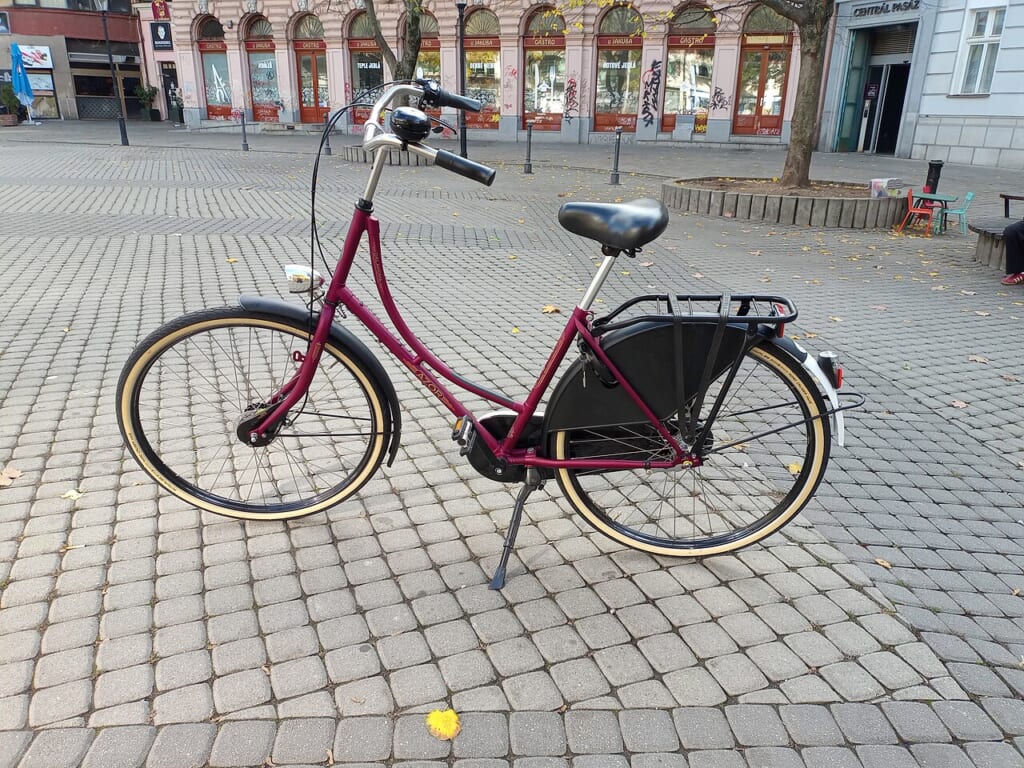
Cover photo: A city bicycle with a matte purple frame, front-wheel brake and gear system. (Photo: Andrej Shadura / CC BY 4.0 / Wikimedia Commons)
Information as of October 2026. For your own health, consult a doctor.
初日の汗は、予約した人だけが持ち帰れる。
2


