
Walking, cycling, and public transport do not have one shared effect
A meta-analysis combined 28 articles involving observational studies of adults. Active commuting, compared with inactive commuting, was associated with an obesity relative risk of 0.88, with a 95% confidence interval of 0.83–0.94. Relative risk describes how the risk of an outcome compares between groups. It is not the percentage of body weight someone will lose, nor does it tell us how many kilograms a changed commute will remove.[1]
Results varied between papers, and all the included studies were observational. Pooling studies can bring their findings together, but it does not turn them into trials that randomly assign transport. The combined estimate needs the same attention to study design as the individual papers. It also cannot provide a single weight-loss dose covering every walking route, bicycle journey, and public transport connection.[1]
Results for walking and cycling are not always consistent. A British longitudinal study used self-reported data from 809 participants. People who maintained cycle commuting had an average BMI 1.14 kg/m² lower at the end of a year than people who did not cycle to work. After adjustment for baseline BMI, however, no significant association remained. Accounting for the difference that was already present at the start changed the interpretation.[6]
The same study found no significant association for maintaining walking. More walking time was associated with a BMI reduction only when the analysis was restricted to people who had not moved home. That reduction was 0.32 kg/m², with a 95% confidence interval of 0.03–0.62 kg/m². Other changes in weekly time spent walking or cycling on the commute were not significantly associated with BMI changes. These less favorable findings belong alongside the positive results.[6]
The walking result depended on the analysis conditions. Which participants are included, how travel is classified, what their initial BMI was, and whether relocation is considered can affect the association observed. For cycling, the result accounting for starting BMI deserves priority over the more appealing unadjusted difference. A commuting label and the actual amount of activity are different pieces of information.[6][7]
A Finnish study followed 1,357 adults for 11 years. Active commuters took an average of 953–1,345 more daily steps than passive commuters. Walkers and public transport users recorded more steps than car users in both summer and winter; cyclists showed that difference only in winter. The seasonal findings underline why it is unwise to treat every active travel category as interchangeable.[7]
The Finnish participants had an average baseline age of 37.4. Researchers collected questionnaires on commuting and physical activity, device measurements using pedometers and accelerometers, and measurements of BMI and waist circumference. That combination allowed them to examine movement and body size through more than commuters’ descriptions alone. The study still followed people’s chosen routines rather than assigning a standardized exercise session.[7]
Public transport need not be excluded from a practical plan. In the large British cross-sectional study, women combining public transport with active travel had a BMI 0.67 kg/m² lower than women using cars alone. The 95% confidence interval was −0.86 to −0.47 kg/m². Japanese follow-up research also reported smaller weight gains among groups whose transitions included public transport. Neither finding specifies the effect of a particular station-to-office walk.[2][18]
You do not have to choose between driving the entire distance and walking all the way to work. A journey can include the route from home to the station, a train ride, and a walk from the station to the workplace. The research offers evidence about groups using different travel arrangements. It leaves the details of your feasible route to be worked out in the place where you actually live and work.
初日の汗は、予約した人だけが持ち帰れる。
A changed commute belongs within a changed life
Start by describing your current journey. Do you drive or walk from home to the station? Do you walk after getting off the train? Is someone collecting you on the return trip? The word “commute” can conceal very different stretches of movement. The British research separated car-only travel, combinations with public transport, and journeys including cycling rather than treating the journey as one uniform activity.[2]
Then distinguish what you can change from what you cannot. Bags, family transport responsibilities, work hours, weather, and road conditions all shape a workable plan. Research linking household income changes with commuting transitions is a reminder that choices have a material setting. Difficulty changing your route is not evidence of poor commitment. The relevant question is which part fits your actual circumstances.[8]
If a new job has increased your car travel, consider whether your tasks and arrival time at home have also changed. If you have begun walking, ask whether you moved home at the same time. The British finding in which increased walking was linked with lower BMI only among people who did not relocate illustrates why the travel change cannot be detached from its wider setting.[6]
Keep activity and body size as separate outcomes. In Finland, people who became active commuters increased daily steps by 763 more than persistent passive commuters. Yet BMI and waist circumference increased over the follow-up overall. More measured movement and falling weight are therefore not interchangeable observations. You can confirm the former without assuming that the latter must immediately follow.[7]
For example, after changing a station-bound segment to walking, you can note whether you actually walked it. If the scale has not fallen, that does not erase the fact that you carried out the route change. Next, consider whether the arrangement remains workable and what the longer-term weight trend looks like. The studies’ averages over years are a poor standard for judging a single morning’s weight.[7][9]
It can be tempting to calculate precise calories from the commute’s distance. These papers examine associations between commuting, body size, and activity; they do not provide calorie expenditure for a specific route through Tachikawa. First identify information you can verify: transport used, segments completed, and the course of your weight. That keeps your observation aligned with the question the studies investigated.
The related feature on breaking up prolonged sitting addresses interruptions to sedentary time, while the running-versus-walking feature examines comparisons between those activities. This commuting feature concerns changing travel that already exists in daily life and examining what follows. Choosing a route that fits your work and household matters more here than constructing a universal ranking of exercise types.

Common misconceptions
“If I start cycling, I will lose the amount seen in the large study.” The average BMI difference of 1.65 kg/m² in women compared existing cycling groups with car-only commuters. The British study following a change from car travel reported a BMI change of −0.30 kg/m². One describes a group difference at a point in time; the other examines a transition over time. Neither promises your own future result.[2][8]
“Active commuting has failed unless weight falls.” In the Japanese 5-year study, people maintaining no leisure exercise and continuing active commuting or public transport still had an average BMI increase of 0.09 kg/m². That increase was smaller than the 0.27 kg/m² among those continuing inactive commuting. Looking only for weight loss would misread a finding about the size of weight gain.[9]
“Cycling looks better, so walking and trains are pointless.” One study did find no significant association between maintained walking and BMI. Other evidence linked combined public and active transport with lower BMI, and Finnish follow-up data showed increased steps after switching toward active commuting. A simple winner-and-loser table would hide differences in design, measurement, and outcomes.[2][6][7]
Averages also cannot choose a safe road for you. Consider rain, the journey home after dark, and days when you carry more than usual. Reading a cycling paper does not settle those practical conditions. Check that a route is safe and sustainable first, and keep weight expectations proportionate to what the studies actually measured.
What you can do today
- On your next work journey, replace a car-covered segment with walking along a safe route. You do not need to walk the whole distance: walking for part of the commute is included in the research definition. The Japanese 1-year follow-up observed an annual weight change of −0.13 kg among workers switching from a car or motorcycle to walking.[3][18]
- On public transport days, try a route with walking before or after the train or bus. In the Japanese 1-year follow-up, workers switching from car or motorcycle to public transport had a weight change of +0.10 kg. The research concerns changes over a year, so approach the route as part of an ongoing routine.[18]
- Keep the walking parts of your journey workable in summer and winter, taking weather and road conditions into account. In the Finnish 11-year follow-up, walkers and public transport users took more daily steps than car users in both seasons. Active commuters averaged 953–1,345 more steps per day than passive commuters; these were observed differences, rather than a prescribed walking amount.[7]
- After changing your route, record the segments actually walked, daily steps, and weight separately. In Finland, people becoming active commuters increased their steps by 763 more per day than persistent passive commuters. If you also move home or change work, add changes in your home, job tasks, and arrival time: the British walking–BMI association differed according to whether people relocated.[6][7][8]
- When reviewing the routine, count the days you completed each segment and compare them with BMI trends in your health examination records. In the Japanese 5-year follow-up, persistent active or public transport commuters who maintained no leisure exercise had a BMI increase of 0.09 kg/m². Consider whether gains have become smaller as well as whether weight has fallen.[9]

Make a weekly stop on your commute at On the Shore Tachikawa
If you want to include exercise on the way home, On the Shore Tachikawa can be a place to keep that habit going alongside the walking parts of your commute.
Before fitting a visit into the return journey, check the prices and trial booking pages. A yoga trial lasts 60 minutes and costs ¥1,980 including tax; the rental items included are a yoga mat, 2 bath towels, and 1 face towel.
From JR Tachikawa Station’s North Exit, the lava-stone hot yoga studio is a 1-minute walk away, on the third floor at 3F Etoile Bldg, 2-14-10 Akebonocho, Tachikawa, Tokyo. For planning around your journey home, it is open every day 8:00–23:30. During pregnancy, guests may choose room-temperature maternity yoga but cannot participate in lava-stone hot yoga. A doctor’s instruction to stop exercising also rules out using the studio.
Many of our yoga instructors speak English, and the studio’s owner often helps guests from the US bases in English herself. The yoga timetable includes more than 25 kinds of lessons, with hot yoga on lava-stone plates as well as room-temperature yoga. Other options include Pilates, HIIT, personal training, boxercise, and women-only kickboxercise. Use the studio website to choose a lesson that fits your commuting route and arrival time at home.
References
- Active commuting and the risk of obesity, hypertension and diabetes: a systematic review and meta-analysis of observational studies — Jian Wu et al., 2021, BMJ Global Health. DOI: 10.1136/bmjgh-2021-005838
- Active commuting and obesity in mid-life: cross-sectional, observational evidence from UK Biobank. — Ellen Flint et al., 2016, The lancet. Diabetes & endocrinology. DOI: 10.1016/s2213-8587(16)00053-x
- Associations between active commuting, body fat, and body mass index: population based, cross sectional study in the United Kingdom — Ellen Flint et al., 2014, The BMJ. DOI: 10.1136/bmj.g4887
- Longitudinal associations of active commuting with body mass index — O. Mytton et al., 2016, Preventive Medicine. DOI: 10.1016/j.ypmed.2016.06.014
- Continuity and Changes in Work Commuting Modes and Their Associations With Overall Physical Activity and Weight Status Among Finnish Adults. — K. Salin et al., 2025, Journal of physical activity & health. DOI: 10.1123/jpah.2024-0644
- Change in commute mode and body-mass index: prospective, longitudinal evidence from UK Biobank — Ellen Flint et al., 2016, The Lancet. Public Health. DOI: 10.1016/s2468-2667(16)30006-8
- Association of changes in commute mode with body mass index and visceral adiposity: a longitudinal study — K. Kuwahara et al., 2019, The International Journal of Behavioral Nutrition and Physical Activity. DOI: 10.1186/s12966-019-0870-x
- Impact of changes in mode of travel to work on changes in body mass index: evidence from the British Household Panel Survey — Adam Martin et al., 2015, Journal of Epidemiology and Community Health. DOI: 10.1136/jech-2014-205211
- Impact of changes in commuting mode on body weight among Japanese workers: a longitudinal study — Atsuko Fukunishi et al., 2024, Journal of Occupational Health. DOI: 10.1093/joccuh/uiae027
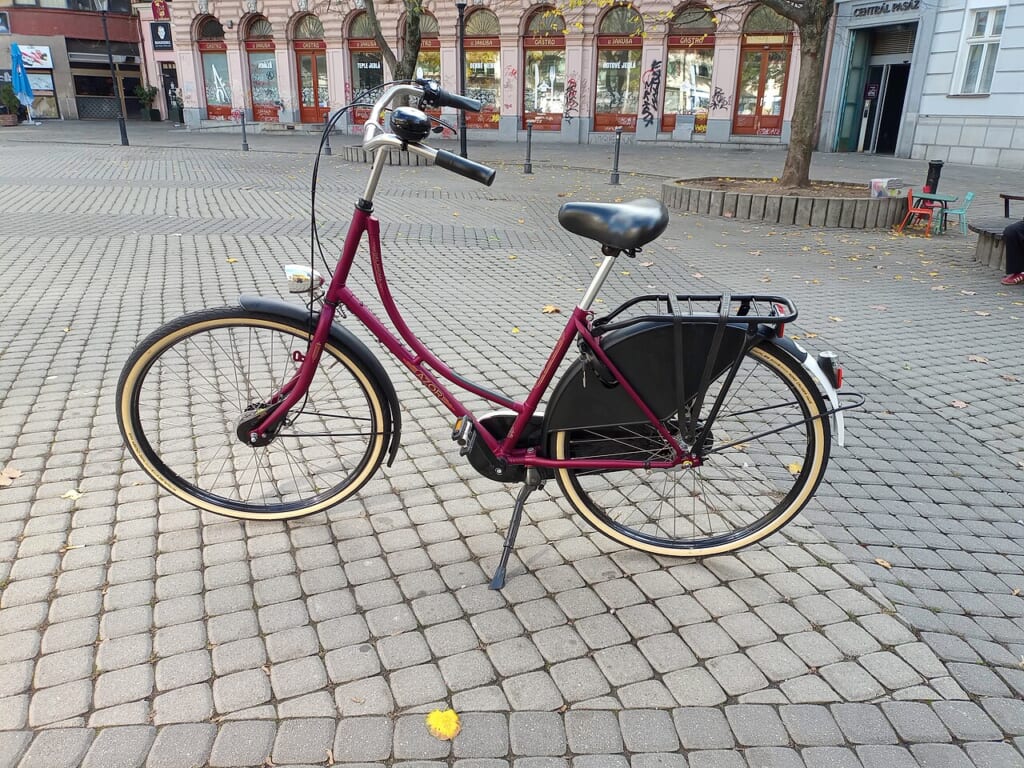
Cover photo: A bicycle with a matte purple frame, internal hub gears, and a hub dynamo. (Photo: Andrej Shadura / CC BY 4.0 / Wikimedia Commons)
Information as of October 2026. For your own health, consult a doctor.
More from Diet Science (English)
- Metabolic adaptation and why your weight loss can slow down
- Body composition and weight loss beyond the bathroom scale
- Food logging and weight loss: what matters beyond perfect records
- Protein and weight loss beyond fullness and the bathroom scale
- Dietary fiber and weight loss: what gut research really shows
- Low-carb vs low-fat diets: what long-term weight loss shows
- Time-restricted eating and weight loss: what trials reveal
- Breakfast and weight loss: what eating or skipping really changes
- Sleep deprivation and appetite: why nighttime snacks add up
- Stress and emotional eating beyond the cortisol explanation
- Aerobic vs resistance training for fat loss and lean mass
- HIIT and body fat loss: what shorter workouts can really offer
- Strength training, metabolism and the science of weight regain
- Yoga and weight loss: what body composition research shows
- Hot yoga calories and sweat: what a lighter scale really means
- Pilates and body composition: what posture and fat studies show
- NEAT and weight loss: what everyday movement can really do
- Daily steps and weight loss: what 8,000 steps really tells us
- Keeping weight off: what long-term maintainers do and how they recover
- Daily self-weighing and weight loss: how to use the numbers
- Water before meals and weight loss: what 500 ml trials show
- Sugary drinks and sweeteners: what replacement means for weight
- Alcohol and weight loss through calories, appetite and fat use
- Ultra-processed foods and overeating through the trial evidence
- Eating rate and weight loss: what slower chewing can change
- Menopause weight gain and why your waist can change first
- Postpartum weight loss through diet, exercise and support
- Sarcopenia and protein: protecting muscle as you grow older
- Visceral fat in men and what exercise changes beyond weight
- Supervised exercise and weight loss: building lasting habits
- GLP-1 drugs and exercise for muscle and weight maintenance
- Weight cycling and metabolism: what 23 studies actually found
- Low GI diets and weight loss: blood sugar is only part of the story
- Mediterranean diet trials separate weight loss from fat loss
- Plant-based diets and weight loss depend on what trials compare
- Snacking frequency alone cannot tell you how weight will change
- Late eating and weight gain: what meal timing trials show
- Portion size and weight loss: change the serving before the plate
- Eating out and weight loss: what meal frequency really tells us
- Menu calorie labeling changes some orders, but results vary
- Coffee and caffeine affect metabolism more clearly than weight
- Green tea catechins and weight loss: what the numbers mean
- Fat burner supplements can raise metabolism without fat loss
- Meal replacements for weight loss and the return to regular food
- Probiotics show small weight differences, not a uniform effect
- Genetics and obesity: what FTO studies say about weight loss
- Weight stigma and self-criticism can accompany daily barriers
- Exercise and appetite: why hunger and eating back calories differ
- Weekend warrior exercise and what it means for weight loss
- Exercise timing and weight loss: morning or evening workouts?
- Fat-burning zone measures fuel use, not future weight loss
- Interval walking for weight loss: what the trials really show
- Stair climbing for weight loss: what fitness studies really show
- Holiday weight gain and why it may still be there in spring
- Menstrual cycle and weight loss: reading hunger and the scale
- Energy density and weight loss without shrinking every meal
- Whole grains and weight loss depend on more than a staple swap
- Nuts and weight loss: why high fat does not mean weight gain
- Body fat measurement accuracy in home scales and DXA scans
- Wearables and weight loss: why more steps may not move the scale
- Alternate-day fasting and 5:2 compared with daily dieting
- Ketogenic diets and weight loss beyond the first few months
- Dairy and calcium have different results in weight-loss trials
- Legumes and weight loss: what fullness can and cannot tell us
- Fish and omega-3 offer no consistent shortcut to weight loss
- Fruit and vegetables for weight loss: what adding more changes
- Meal sequence and blood sugar: what vegetables first can change
- Distracted eating and why lunch can affect your next snack
- Social eating and weight loss: how friends shape meal size
- Home food environment connects shopping, meals and weight
- Mindful eating and weight loss: what changes beyond the scale
- Implementation intentions can help diet and exercise plans work
- Financial incentives for weight loss and what happens afterward
- Social support and weight loss depend on what a partner does
- Rapid versus gradual weight loss and what happens afterward
- Food diary underreporting and why calorie totals can mislead
- BMR estimation equations can miss your individual metabolism
- Sedentary breaks change blood sugar without proving weight loss
- Swimming and weight loss: what changes beyond the scales?
- Running vs walking changes the comparison for weight loss
- Resistance training volume and frequency for muscle and fat
- Cold exposure activates brown fat but may not reduce weight
- Sauna and bathing for weight loss: what the scale cannot tell
- Weight loss and bone density depend on diet and exercise
- Weight loss and mood: why mental health follows its own path
- Shift work and weight gain beyond the late-night snack story
- Remote work changes meals, but weight gain is not inevitable
- Weekly weight fluctuations and what a Monday gain really means
- High-protein diet types and what their weight-loss results mean
All Diet Science articles (English)
初日の汗は、予約した人だけが持ち帰れる。
2


