

What the trials reporting weight loss actually did
A pilot study of 26 young women with overweight or obesity found a different weight result. The average age was 25.4 years. Participants were randomly assigned to stair exercise or a non-exercising control group. Supervised sessions included a three-minute warm-up and three vigorous 20-second ascents, separated by two-minute recovery periods. The 10-minute session was performed five times a week for four weeks[2].
In the exercise group, weight fell from 66.5 to 65.2 kg, waist circumference from 78.0 to 76.5 cm, and peak oxygen uptake increased from 31.6 to 34.9 mL/kg/min. The study reported group-by-time interactions for these outcomes[2]. In plain language, the analysis considered whether the pattern of change over time differed between the exercise and control groups, rather than merely noting that the exercise group’s average changed.
Each group initially contained 13 women, and the stair protocol comprised 20 supervised sessions over four weeks. The exercise group’s body mass index, or BMI, declined from 24.8 to 24.4. Improvements in weight, waist circumference and cardiorespiratory fitness were statistically significant in comparison with controls[2]. The abstract does not provide a confidence interval for the weight change. The averages and significant results should therefore be read alongside the small size of the trial.
The men’s trial found no weight loss, whereas the women’s pilot study did[1][2]. This does not establish that women respond better than men. They were separate studies, not a comparison of men and women within one trial. Average BMI was 27.1 in the men’s sample and 25.3 in the women’s sample, so the participant profiles also differed[1][2]. Similar exercise descriptions cannot remove those differences or make sex the demonstrated explanation.
Another study in adult women compared home-based stair climbing with continuous stair exercise in a gym. Inactive women were randomly assigned to home training, with 26 participants, or gym training, with 24. Their average age was 31.7 years. They trained five days a week for eight weeks, starting with two ascents a day and progressing to five a day in weeks seven and eight[3].
Each ascent involved 32.8 m of vertical climbing, and the home protocol matched the vertical displacement of the gym protocol. Relative to controls, stair climbing reduced weight by 0.99 kg and improved maximum oxygen uptake by 1.63 mL/kg/min. The 95% confidence interval for the fitness change was 1.21–2.05[3].
The home participants climbed up and down stairs, while the gym participants performed continuous stair climbing. Similar improvements were reported in both settings[3]. Matching vertical displacement made the comparison more meaningful than simply comparing two locations with unspecified amounts of exercise. The home approach also followed a planned increase in repetitions. This was not a study showing that any amount of household stair use produces the same outcome.
LDL cholesterol decreased by 0.20 mmol/L and triglycerides by 0.21 mmol/L, with similar lipid improvements in the home and gym groups. Fasting blood glucose decreased only in the home group[3]. Again, some results aligned across the settings and another did not. A single weight figure cannot describe all of those findings, and similar results for one outcome do not imply identical results for every measurement.
Together, these studies support the possibility of weight loss with some stair exercise programs[2][3]. They do not provide a guaranteed response to a particular number of steps. Their training periods, supervision, participants and exercise arrangements belong beside the weight changes. For someone hoping to lose weight, that is a more useful expectation than treating a small trial’s average as a personal forecast.
初日の汗は、予約した人だけが持ち帰れる。
Going down and burning fat need separate measurements
A randomized controlled trial compared descending and ascending stairs in 36 young Chinese women with obesity. Participants were assigned to descending exercise, ascending exercise or a control group. The exercise groups trained three times a week for 12 weeks, with a gradual increase in repetitions. Body composition measures declined in the exercise groups, but abdominal fat decreased only in the descending group[4].
Body composition was measured using dual-energy X-ray absorptiometry. The researchers also examined insulin sensitivity, meaning the body’s response to insulin, and reported a greater improvement in the descending group. Insulin fell by 33.2% with descending exercise and 9.8% with ascending exercise. An index assessing insulin resistance fell by 35.6% and 10.8%, respectively[4]. Insulin resistance refers to the degree to which insulin works less effectively.
The inflammatory marker tumor necrosis factor alpha declined by 39.9% in the descending group and 23.2% in the ascending group. Its reduction was significantly greater in the descending group than in the other groups. Another inflammatory marker, interleukin-6, decreased significantly with both exercise protocols[4]. These were measured metabolic and inflammatory outcomes, rather than a conclusion inferred from weight alone.
The abstract does not give detailed amounts or confidence intervals for the body composition reductions[4]. That limits how precisely the change can be described here. The participants were young women with obesity, so the comparison should remain attached to that population. Someone concerned about their knees should ask a doctor before choosing an exercise approach on the basis of the descending group’s favorable results.
Fat use during exercise is another distinct question. In the 126-step trial, the stair group’s fitness improved, but maximal fat oxidation rate did not change among the stair, cycling and control groups[8]. Maximal fat oxidation is a measure of the greatest rate at which fat is used during exercise. It is not a measurement of how much body fat a person has.
It is tempting to imagine better fitness, greater fat use and lower weight as a single sequence of results. This trial measured fitness and maximal fat oxidation and found different responses[8]. That is why a hard climb cannot be read as proof of a large effect on fat burning or body fat. The neighboring article on the fat-burning zone examines the wider issue; the stair evidence already shows why the outcomes need separate labels.
In daily life, it may help to keep a record of stair activity separate from weight measurements. This is an organizational suggestion, not a proven method for guaranteeing weight loss. A record of what you did answers a different question from a record of what changed. The trials in which fitness and body composition did not move together explain why both questions deserve their own space[1][18].
Common misconceptions
“One fixed number of steps will make anyone lose weight.” The trials using 60, 126 and 145 steps did not compare different step counts in the same people. They differed in intensity, repetitions, recovery and participants, and their main reported gains were in cardiorespiratory fitness[8][13][18]. A step count describes a research condition. It is not a shared pass mark for weight loss.
“Short exercise means intensity does not matter.” Some brief stair protocols involved all-out efforts, while another specified at least 80% of age-predicted maximum heart rate[1][5][8]. Brief and gentle are different descriptions. A protocol that sounds convenient because the ascent is short still needs to be read in full. Trying to reproduce an all-out research effort in a crowded station is not an appropriate interpretation of these findings.
“No weight change means the stairs achieved nothing.” The young men’s four-week trial found improved fitness without changes in weight or body fat[1]. The small women’s trial did report weight loss[2]. Both findings belong in the evidence. Keeping the fitness outcome visible and attaching weight-loss expectations to the participants and methods gives a more faithful account than dismissing the exercise or promising that weight must fall.
What you can do today
- Start with one stair climb a day in week one, five days a week, following the employee trial’s gradual structure. Add one daily climb every two weeks, reaching three a day in week five[18]. Choose a staircase and pace you can manage safely rather than sprinting up the stairs.
- When a longer exercise period is difficult to arrange, split stair opportunities into three bouts a day, leaving 1–4 hours between them. Use the frequency and spacing of the 60-step trial as a guide[13]. Avoid copying its vigorous climbs at maximum speed, and choose another route when crowds or uncertain footing make the stairs unsuitable.
- Make time to warm up before climbing and recover between repeated ascents. The young men’s trial used a three-minute warm-up and two-minute recovery periods between climbs[1]. If you have a medical condition, pain or concerns about exercising, check with a doctor before starting.
- Record step count, pace, number of bouts and recovery intervals together. Three daily bouts performed within one session and three spread across the day describe different arrangements, so compare more than the step total[1][13].
- If you weigh yourself, review your stair activity record and weight results separately. In the men’s four-week trial, fitness improved while weight and body fat remained unchanged[1].

Planning a route for regular movement at On the Shore Tachikawa
After considering the stairs on your daily route, you can also look at a place where you can keep an exercise habit going. On the Shore Tachikawa is close to the station, so its location and lesson times can be considered together with your journey.
The studio is open every day 8:00–23:30 and is a one-minute walk from the North Exit of JR Tachikawa Station. Its address is 3F Etoile Bldg, 2-14-10 Akebonocho, Tachikawa, Tokyo.
A trial yoga lesson costs ¥1,980 including tax. The 60-minute lesson includes two bath towels, one face towel and mat rental. The prices and trial booking pages let you check the arrangements alongside your route from the station and the time you can set aside.
Many of our yoga instructors speak English, and the studio’s owner often helps guests from the US bases in English herself.
Alongside hot yoga in a studio laid with lava-stone plates, options include room-temperature yoga, Pilates and personal training. There are more than 25 kinds of yoga lessons.
Pregnant guests cannot join lava-stone hot yoga; room-temperature maternity yoga is available. Guests who have been told by a doctor not to exercise cannot join. Check the studio website when considering participation.
References
- Effect of brief intense stair climbing on cardiorespiratory fitness and metabolic risk factors in inactive young men with obesity: A randomized controlled trial. — Minsub Han et al., 2025, Nutrition, metabolism, and cardiovascular diseases : NMCD. DOI: 10.1016/j.numecd.2025.103902
- Effect of Short Bouts of Vigorous Stair Climbing on Cardiorespiratory Fitness in Women with Overweight and Obesity: A Pilot Feasibility Study — JeongEun Yun et al., 2023, Journal of Obesity & Metabolic Syndrome. DOI: 10.7570/jomes23024
- Home-Based Stair Climbing as an Intervention for Disease Risk in Adult Females; A Controlled Study — E. Michael et al., 2021, International Journal of Environmental Research and Public Health. DOI: 10.3390/ijerph18020603
- Effects of descending or ascending stair exercise on body composition, insulin sensitivity, and inflammatory markers in young Chinese women with obesity: A randomized controlled trial — B. Chow et al., 2020, Journal of Sports Sciences. DOI: 10.1080/02640414.2020.1829362
- Brief Intense Stair Climbing Improves Cardiorespiratory Fitness — Mary K. Allison et al., 2017, Medicine & Science in Sports & Exercise. DOI: 10.1249/mss.0000000000001188
- Exercise Snacks are a Time-Efficient Alternative to Moderate-Intensity Continuous Training for Improving Cardiorespiratory Fitness but not Maximal Fat Oxidation in Inactive Adults: A Randomized Controlled Trial. — Ming-Yue Yin et al., 2024, Applied physiology, nutrition, and metabolism = Physiologie appliquee, nutrition et metabolisme. DOI: 10.1139/apnm-2023-0593
- Stair-climbing interventions on cardio-metabolic outcomes in adults: A scoping review — Anang M. Ghosal et al., 2023, Journal of Taibah University Medical Sciences. DOI: 10.1016/j.jtumed.2023.10.003
- Do stair climbing exercise “snacks” improve cardiorespiratory fitness? — E. Jenkins et al., 2019, Applied physiology, nutrition, and metabolism = Physiologie appliquee, nutrition et metabolisme. DOI: 10.1139/apnm-2018-0675
- Training effects of short bouts of stair climbing on cardiorespiratory fitness, blood lipids, and homocysteine in sedentary young women — C. Boreham et al., 2005, British Journal of Sports Medicine. DOI: 10.1136/bjsm.2002.001131
- Evaluating the effects of a low volume stairclimbing programme on measures of health-related fitness in sedentary office workers. — R. Kennedy et al., 2007, Journal of sports science & medicine. DOI: none listed
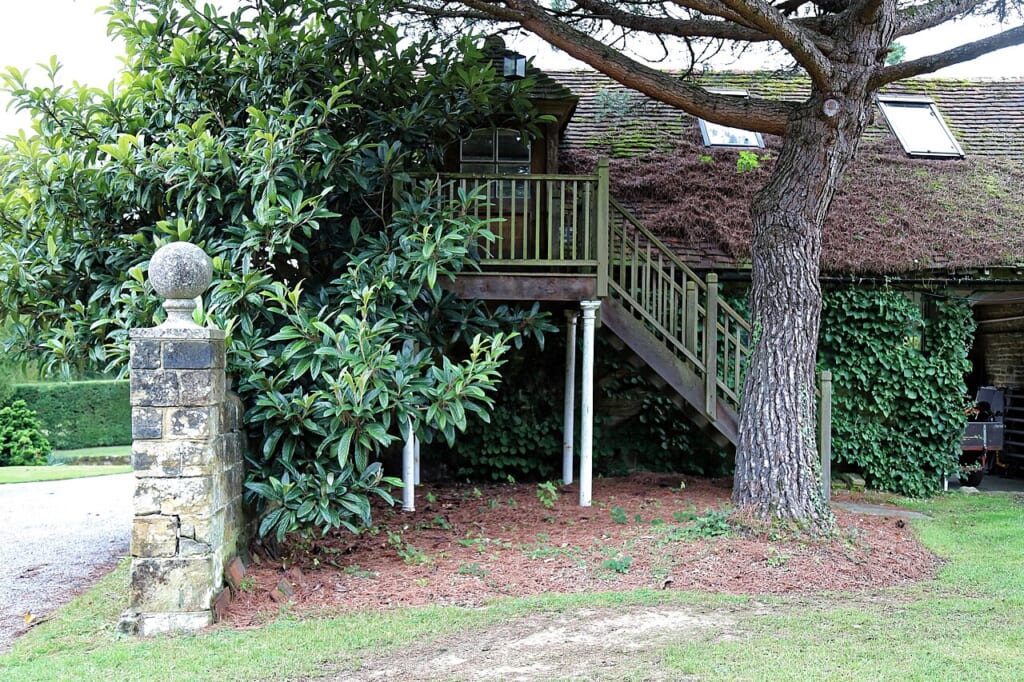
Cover photo: An outdoor staircase beside a barn leads to the adjoining building. (Photo: Acabashi / CC BY-SA 4.0 / Wikimedia Commons)
Information as of October 2026. For your own health, consult a doctor.
More from Diet Science (English)
- Metabolic adaptation and why your weight loss can slow down
- Body composition and weight loss beyond the bathroom scale
- Food logging and weight loss: what matters beyond perfect records
- Protein and weight loss beyond fullness and the bathroom scale
- Dietary fiber and weight loss: what gut research really shows
- Low-carb vs low-fat diets: what long-term weight loss shows
- Time-restricted eating and weight loss: what trials reveal
- Breakfast and weight loss: what eating or skipping really changes
- Sleep deprivation and appetite: why nighttime snacks add up
- Stress and emotional eating beyond the cortisol explanation
- Aerobic vs resistance training for fat loss and lean mass
- HIIT and body fat loss: what shorter workouts can really offer
- Strength training, metabolism and the science of weight regain
- Yoga and weight loss: what body composition research shows
- Hot yoga calories and sweat: what a lighter scale really means
- Pilates and body composition: what posture and fat studies show
- NEAT and weight loss: what everyday movement can really do
- Daily steps and weight loss: what 8,000 steps really tells us
- Keeping weight off: what long-term maintainers do and how they recover
- Daily self-weighing and weight loss: how to use the numbers
- Water before meals and weight loss: what 500 ml trials show
- Sugary drinks and sweeteners: what replacement means for weight
- Alcohol and weight loss through calories, appetite and fat use
- Ultra-processed foods and overeating through the trial evidence
- Eating rate and weight loss: what slower chewing can change
- Menopause weight gain and why your waist can change first
- Postpartum weight loss through diet, exercise and support
- Sarcopenia and protein: protecting muscle as you grow older
- Visceral fat in men and what exercise changes beyond weight
- Supervised exercise and weight loss: building lasting habits
- GLP-1 drugs and exercise for muscle and weight maintenance
- Weight cycling and metabolism: what 23 studies actually found
- Low GI diets and weight loss: blood sugar is only part of the story
- Mediterranean diet trials separate weight loss from fat loss
- Plant-based diets and weight loss depend on what trials compare
- Snacking frequency alone cannot tell you how weight will change
- Late eating and weight gain: what meal timing trials show
- Portion size and weight loss: change the serving before the plate
- Eating out and weight loss: what meal frequency really tells us
- Menu calorie labeling changes some orders, but results vary
- Coffee and caffeine affect metabolism more clearly than weight
- Green tea catechins and weight loss: what the numbers mean
- Fat burner supplements can raise metabolism without fat loss
- Meal replacements for weight loss and the return to regular food
- Probiotics show small weight differences, not a uniform effect
- Genetics and obesity: what FTO studies say about weight loss
- Weight stigma and self-criticism can accompany daily barriers
- Exercise and appetite: why hunger and eating back calories differ
- Weekend warrior exercise and what it means for weight loss
- Exercise timing and weight loss: morning or evening workouts?
- Fat-burning zone measures fuel use, not future weight loss
- Interval walking for weight loss: what the trials really show
- Holiday weight gain and why it may still be there in spring
- Menstrual cycle and weight loss: reading hunger and the scale
- Energy density and weight loss without shrinking every meal
- Whole grains and weight loss depend on more than a staple swap
- Nuts and weight loss: why high fat does not mean weight gain
- Body fat measurement accuracy in home scales and DXA scans
- Wearables and weight loss: why more steps may not move the scale
All Diet Science articles (English)
初日の汗は、予約した人だけが持ち帰れる。
2

